New Zealand vs India, 3rd T20I, India tour of New Zealand 2026 – Commentary
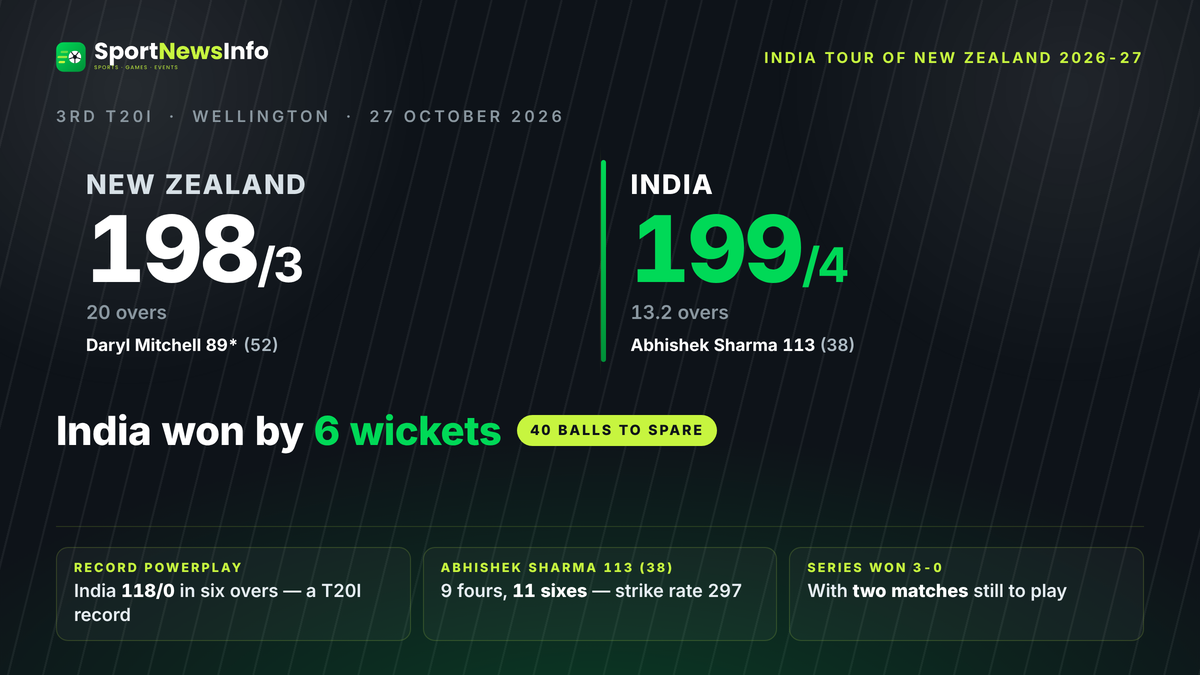
India beat New Zealand by six wickets at Hnry Stadium, Wellington on Tuesday, chasing 199 in 13.2 overs with 40 balls to spare, and took an unassailable 3-0 lead in the five-match series.
The number that explains it is not the margin but the powerplay. India were 118 for 0 after six overs — the highest powerplay score in the history of T20 Internationals. Abhishek Sharma made 113 from 38 balls with nine fours and eleven sixes, reaching fifty off 15 and his hundred off 35, and was named Player of the Match.
New Zealand had done very little wrong. Daryl Mitchell finished unbeaten on 89 from 52 and their 198 for 3 was a strong total at this ground. It lasted less than fourteen overs.
New Zealand vs India 3rd T20I – Match Summary
| Match | New Zealand v India, 3rd T20I |
|---|---|
| Series | India tour of New Zealand, 2026-27 |
| Venue | Hnry Stadium, Wellington |
| Date | Tuesday, 27 October 2026 |
| Start | 8:00 PM local · 7:00 AM GMT · 12:30 PM IST |
| Toss | India won the toss and elected to field |
| New Zealand | 198/3 in 20 overs (run rate 9.90) |
| India | 199/4 in 13.2 overs (run rate 14.92) |
| Result | India won by 6 wickets (40 balls remaining) |
| Player of the Match | Abhishek Sharma — 113 from 38 balls |
| Series | India lead 3-0 and have won the series |
| Umpires | Chris Brown and Cory Black; third umpire Shaun Haig |
| Match referee | Ranjan Madugalle |
New Zealand Innings – Daryl Mitchell’s Unbeaten 89
India bowled first for the third match running and struck almost immediately. Arshdeep Singh had Tim Seifert caught by Axar Patel for 2 in the second over, leaving New Zealand 4 for 1.
What followed was the innings’ most destructive passage. Finn Allen and Daryl Mitchell added 86 for the second wicket from 43 balls, and Allen’s contribution was unusual even by his standards: 40 from 25 balls containing five sixes and not a single four. Nitish Kumar Reddy eventually had him caught by Naman Dhir at 90 for 2 in the ninth over.
Glenn Phillips made 17 from 14 with three fours before Axar Patel took a return catch to remove him at 123 for 3 in the twelfth. That was the last success India had.
Mitchell finished 89 not out from 52 balls with five fours and five sixes, having batted from the third over to the last. His unbroken fourth-wicket stand with Bevon Jacobs, who made 39 not out from 23 with four fours and a six, was worth 75 from 48 balls and carried New Zealand from 123 to 198.
New Zealand’s powerplay yielded 58. Their last ten overs produced more than half the innings. On most nights 198 is a winning score in Wellington.
India Bowling Performance
There is no comfortable way to read India’s analysis. Not one of the five bowlers went at under eight an over, and three conceded at nine or more.
Arshdeep Singh was the pick with 1 for 33 from his four, an economy of 8.20, and his early dismissal of Seifert was the only genuine breakthrough of the powerplay. Axar Patel’s 1 for 36 and Nitish Kumar Reddy’s 1 for 38 each produced a wicket at a cost.
The two that will concern India are Bhuvneshwar Kumar’s 0 for 40 at ten an over — a second expensive outing in three matches since his recall — and Prince Yadav’s 0 for 44 at 11.00, the most expensive spell of the night. India also bowled four wides to go with seven leg byes conceded.
India have now conceded 180, 198 and 198 in three matches, and have won all three. That is a strange way to go 3-0 up, and it is the one thing in this series the batting keeps covering for.
India’s Chase – Abhishek Sharma’s 113 from 38 Balls
Chasing 199 at close to ten an over, India did not build an innings so much as detonate one.
Abhishek Sharma and Vaibhav Sooryavanshi put on 133 for the first wicket from 43 balls. By the end of the sixth over India were 118 for 0 — the highest powerplay score ever made in a men’s T20 International. The required rate, which started at 9.95, had already collapsed to under six.
Sooryavanshi made 45 from 19 balls with four fours and four sixes, a strike rate of 236, and was still the junior partner by some distance. Matthew Fisher — in the squad only as cover for this fixture — had him caught by Daryl Mitchell at 133 in the eighth over.
Abhishek’s innings is the one that will be replayed. Fifty from 15 balls. Hundred from 35. Out for 113 from 38, caught by Glenn Phillips off Kyle Jamieson at 178 for 2 in the tenth over. Nine fours, eleven sixes, and 102 of his 113 runs in boundaries — a strike rate of 297.37.
What remained was a formality that India very nearly made untidy. Sanju Samson made 18 from 13 before Jamieson bowled him, and Shreyas Iyer fell for 5 from 10, caught by Phillips off Mitchell Santner. India lost three wickets for 21 runs between the 10th and 14th overs.
It did not matter. Tilak Varma was unbeaten on 1 and Naman Dhir on 4 from a single ball when India passed the target in the fourteenth over.
New Zealand Bowling Performance
One New Zealand bowler emerged with his reputation enhanced, and it was the captain.
Mitchell Santner’s 3-0-17-1 is an extraordinary analysis in a match where his side conceded 199 in 13.2 overs. An economy of 5.70 on a night when every other bowler went at 13 or more, and the wicket of the opposition captain. He was the only bowler India could not get away.
Kyle Jamieson took 2 for 45 from 3.2 overs, including Abhishek and Samson, and Matthew Fisher 1 for 23 from his single over. Beyond that the figures are brutal: Jacob Duffy 0 for 44 from two overs at 22.00, with five wides; Adam Milne 0 for 33 from two; Michael Bracewell 0 for 36 from two.
New Zealand’s extras also hurt — ten wides and two no-balls among India’s 13, which is eleven free deliveries in an innings that lasted only 80.
Records Set in Wellington
This was a night of genuine record-keeping rather than the loose kind.
- India’s 118 for 0 is the highest powerplay score in men’s T20I history.
- Abhishek Sharma’s 11th T20 century across all T20 cricket passes Virat Kohli’s 10 for the most by an India batter. Worldwide he is third, behind Chris Gayle (22) and Babar Azam (13).
- His 35-ball hundred is the joint second-fastest by an Indian in T20Is. The record is his own 30-ball century against Afghanistan earlier in 2026.
- It is the highest score by an India batter in a successful T20I chase, passing Shreyas Iyer’s unbeaten 102 against West Indies, and the second-highest in any T20I chase by an Indian behind Suryakumar Yadav’s 117 in a defeat to England in 2022.
- It is the second-highest score by a visiting batter in New Zealand, behind Richard Levi’s 117 not out in 2012.
- He became the ninth batter to reach 150 T20I sixes, and is third among India batters behind Rohit Sharma and Suryakumar Yadav.
- His fourth T20I century draws him level with Suryakumar Yadav, Phil Salt and Karanbir Singh; Rohit Sharma and Glenn Maxwell lead on five.
India’s hundred was also reported as the fastest team century in T20I history, raised inside five overs. That claim appears in one report and is worth confirming against the official records before it is repeated as settled.
Fall of Wickets
New Zealand — 198/3 (20 overs)
| Wicket | Batter | Score | Over |
|---|---|---|---|
| 1 | Tim Seifert | 4-1 | 1.2 |
| 2 | Finn Allen | 90-2 | 8.3 |
| 3 | Glenn Phillips | 123-3 | 11.6 |
India — 199/4 (13.2 overs)
| Wicket | Batter | Score | Over |
|---|---|---|---|
| 1 | Vaibhav Sooryavanshi | 133-1 | 7.1 |
| 2 | Abhishek Sharma | 178-2 | 9.6 |
| 3 | Shreyas Iyer | 193-3 | 12.4 |
| 4 | Sanju Samson | 195-4 | 13.1 |
Full Scorecard
New Zealand batting
| Batter | Dismissal | R | B | 4s | 6s | SR |
|---|---|---|---|---|---|---|
| Tim Seifert (wk) | c Axar Patel b Arshdeep Singh | 2 | 6 | 0 | 0 | 33.33 |
| Finn Allen | c Naman Dhir b Nitish Kumar Reddy | 40 | 25 | 0 | 5 | 160.00 |
| Daryl Mitchell | not out | 89* | 52 | 5 | 5 | 171.15 |
| Glenn Phillips | c and b Axar Patel | 17 | 14 | 3 | 0 | 121.43 |
| Bevon Jacobs | not out | 39* | 23 | 4 | 1 | 169.57 |
Extras 11 (7 leg byes, 4 wides). Total: 198 for 3 in 20 overs, run rate 9.90. Did not bat: Michael Bracewell, Mitchell Santner (c), Kyle Jamieson, Adam Milne, Jacob Duffy, Matthew Fisher. Powerplay: 58 runs.
India bowling
| Bowler | O | M | R | W | Econ |
|---|---|---|---|---|---|
| Arshdeep Singh | 4 | 0 | 33 | 1 | 8.20 |
| Axar Patel | 4 | 0 | 36 | 1 | 9.00 |
| Nitish Kumar Reddy | 4 | 0 | 38 | 1 | 9.50 |
| Bhuvneshwar Kumar | 4 | 0 | 40 | 0 | 10.00 |
| Prince Yadav | 4 | 0 | 44 | 0 | 11.00 |
India batting
| Batter | Dismissal | R | B | 4s | 6s | SR |
|---|---|---|---|---|---|---|
| Vaibhav Sooryavanshi | c Daryl Mitchell b Matthew Fisher | 45 | 19 | 4 | 4 | 236.84 |
| Abhishek Sharma | c Glenn Phillips b Kyle Jamieson | 113 | 38 | 9 | 11 | 297.37 |
| Sanju Samson (wk) | b Kyle Jamieson | 18 | 13 | 2 | 0 | 138.46 |
| Shreyas Iyer (c) | c Glenn Phillips b Mitchell Santner | 5 | 10 | 0 | 0 | 50.00 |
| Tilak Varma | not out | 1* | 1 | 0 | 0 | 100.00 |
| Naman Dhir | not out | 4* | 1 | 1 | 0 | 400.00 |
Extras 13 (10 wides, 2 no-balls, 1 leg bye). Total: 199 for 4 in 13.2 overs, run rate 14.92. Did not bat: Nitish Kumar Reddy, Axar Patel, Bhuvneshwar Kumar, Arshdeep Singh, Prince Yadav. Powerplay: 118 runs for no wicket.
New Zealand bowling
| Bowler | O | M | R | W | Econ |
|---|---|---|---|---|---|
| Mitchell Santner (c) | 3 | 0 | 17 | 1 | 5.70 |
| Kyle Jamieson | 3.2 | 0 | 45 | 2 | 13.50 |
| Matthew Fisher | 1 | 0 | 23 | 1 | 23.00 |
| Adam Milne | 2 | 0 | 33 | 0 | 16.50 |
| Michael Bracewell | 2 | 0 | 36 | 0 | 18.00 |
| Jacob Duffy | 2 | 0 | 44 | 0 | 22.00 |
Key Turning Points
- The Allen–Mitchell stand of 86 from 43 balls. From 4 for 1, it rebuilt New Zealand’s innings and set up a total that looked more than competitive.
- Mitchell and Jacobs adding 75 unbroken from 48. New Zealand’s last eight overs turned 123 for 3 into 198 for 3.
- India’s first six overs. 118 for 0 removed the contest before it had properly begun. A chase of 199 became a chase of 81 from 84 balls.
- Abhishek reaching fifty from 15 balls. By the time New Zealand could change the bowling, the required rate had already fallen below six.
- Santner’s three overs for 17. The only passage of the chase New Zealand controlled, and evidence that the pitch was not the whole explanation.
What the Result Means for the Series
India have won the series with two matches to spare, leading 3-0. The margins tell their own story: four wickets, four wickets, and now six wickets with 40 balls unused.
For New Zealand the pattern is becoming uncomfortable. They have made 180, 198 and 198 across the three matches — competitive totals in every case — and lost all three. Mitchell Santner has bowled beautifully throughout, including 4 for 21 at Christchurch, and his side has nothing to show for it.
For India the question is the bowling rather than the batting. Three matches, three totals of 180 or more conceded, and a seam attack operating without Jasprit Bumrah. Bhuvneshwar Kumar’s economy since his recall is the specific concern.
The fourth T20I is at Eden Park, Auckland on Friday, 30 October, where the short square boundaries will do nothing to help New Zealand’s bowlers, and the fifth is at Seddon Park, Hamilton on 1 November.
Frequently Asked Questions
Who won the New Zealand vs India 3rd T20I?
India won by six wickets at Hnry Stadium, Wellington on 27 October 2026, chasing 199 in 13.2 overs with 40 balls to spare. The win gave India an unassailable 3-0 series lead.
How many runs did Abhishek Sharma score?
Abhishek Sharma made 113 from 38 balls with nine fours and eleven sixes, a strike rate of 297.37. He reached fifty off 15 balls and his hundred off 35.
What was New Zealand’s score?
New Zealand made 198 for 3 in their 20 overs. Daryl Mitchell was unbeaten on 89 from 52 balls and Bevon Jacobs 39 not out from 23.
What record did India set in the powerplay?
India scored 118 for no wicket in the first six overs — the highest powerplay score in men’s T20 International history.
Who was Player of the Match?
Abhishek Sharma, for his 113 from 38 balls. It is the highest score by an India batter in a successful T20I run chase.
Who took the most wickets?
Kyle Jamieson, with 2 for 45 for New Zealand. India’s wickets were shared by Arshdeep Singh, Axar Patel and Nitish Kumar Reddy, one each.
What is the series score?
India lead 3-0 in the five-match series and have won it with two matches still to play.
When is the fourth T20I?
Friday, 30 October 2026 at Eden Park, Auckland. The fifth and final T20I is at Seddon Park, Hamilton on 1 November.
Conclusion
New Zealand made 198 and were beaten before the eighth over. That is the whole match, and it is almost entirely down to one passage of batting: 118 without loss in the powerplay, a T20I record, built by a 19-year-old making 45 from 19 and a 26-year-old making the fastest hundred of his international career.
Abhishek Sharma now has more T20 centuries than Virat Kohli, the highest score by an Indian in a successful T20I chase, and 150 T20I sixes. Daryl Mitchell’s unbeaten 89 and Mitchell Santner’s 3-0-17-1 deserved better than a six-wicket defeat.
India go to Eden Park on Friday with the series already won. Follow our cricket section for the fourth T20I preview, full scorecards and series coverage.
Published: 27 October 2026. Every figure in this report comes from the official scorecard and both innings reconcile exactly: New Zealand’s 187 off the bat plus 11 extras makes 198, and India’s 186 plus 13 extras makes 199. Records are sourced to published reports and are attributed where a single source carries them.