Sri Lanka vs England, 3rd Match, Pakistan ODI Tri-Series 2026 – Full Scorecard and Highlights
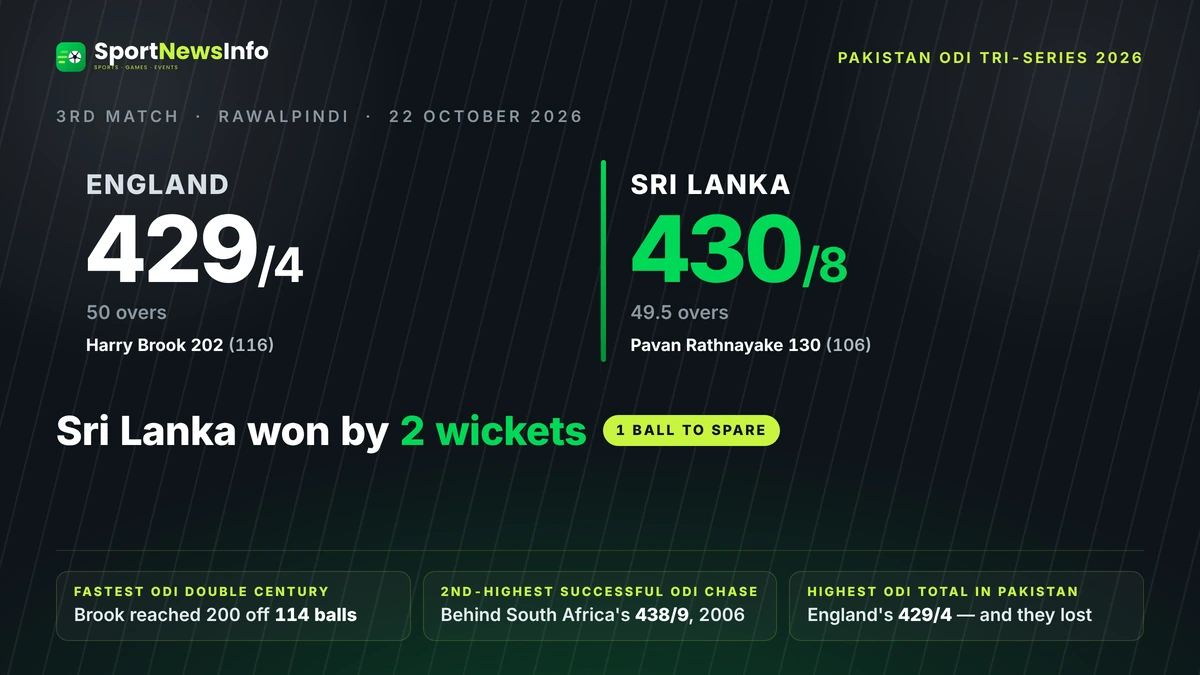
Harry Brook scored the fastest double century in the history of One Day International cricket, and lost. His 202 off 116 balls carried England to 429 for 4 at the Rawalpindi Cricket Stadium on Thursday 22 October 2026. Sri Lanka then chased 430, getting there with a ball to spare to win by two wickets — the second-highest successful run chase in men’s ODI history.
Pavan Rathnayake made 130 off 106 balls to anchor it, Avishka Fernando and Dasun Shanaka were both dismissed on 97, and Janith Liyanage finished unbeaten on 61 from 27 balls. Between them they turned the highest total ever made in an ODI in Pakistan into a losing one.
Sri Lanka vs England 2026 – Match Summary
| Match | England v Sri Lanka, 3rd Match |
|---|---|
| Series | Pakistan ODI Tri-Series, 2026-27 (with Pakistan) |
| Venue | Rawalpindi Cricket Stadium, Rawalpindi |
| Date | Thursday, 22 October 2026 (day-night) |
| Toss | Sri Lanka won the toss and elected to bowl |
| England | 429/4 in 50 overs |
| Sri Lanka | 430/8 in 49.5 overs |
| Result | Sri Lanka won by 2 wickets (1 ball remaining) |
| Player of the Match | Not published at the time of writing |
England Post 429/4 After Harry Brook’s Double Century
Sri Lanka put England in, and for sixteen overs the decision looked defensible. England were 85 for 2 at that point, having lost both openers.
Tom Banton made 50 from 51 balls with nine fours, a controlled innings that never quite accelerated, and Ben Duckett’s 29 came from 39 — a slower rate than either would have wanted on this surface. Neither hit a six. At 85 for 2 England were scoring at a touch over five an over, which on the evidence of what followed was barely half the ground’s going rate.
Then Brook arrived at the crease with Joe Root, and the innings changed shape entirely.
Root made 69 from 66 balls with eight fours — again no sixes — and the pair added 159 for the third wicket before Root fell in the 38th over with England on 244. That stand did two things: it repaired the start, and it gave Brook the time to get in. By the time Root departed, Brook was set and the last twelve overs were available.
What came next was the most productive passage of the innings. Brook and Will Jacks added 185 for the fourth wicket in a little over twelve overs. Jacks finished on 66 not out from just 30 balls, with eight fours and three sixes — a strike rate of 220 — and England took 185 runs from their last 12.2 overs.
England closed on 429 for 4, with 13 extras. It is the highest total ever made in an ODI in Pakistan. It was not enough.
Harry Brook Smashes 202 Against Sri Lanka
Brook’s innings deserves its own accounting, because several records moved at once.
| Runs | 202 |
|---|---|
| Balls faced | 116 |
| Balls to reach 200 | 114 |
| Fours | 21 |
| Sixes | 10 |
| Strike rate | 174.14 |
| Fifty | off 42 balls |
| Hundred | off 75 balls |
| Dismissal | Caught off the final ball of the innings |
Two of those numbers matter and they are different from each other. Brook faced 116 balls in all, and reached 200 off 114. The world record for the fastest ODI double century is measured by balls taken to reach 200, so 114 is the record figure — and it beat Shubman Gill’s 117 balls, set against West Indies at Guwahati on 30 September. Gill’s record had lasted 22 days. Brook was three balls quicker.
The milestone sequence shows how the innings was built. Fifty off 42 balls is brisk but ordinary by modern standards. The hundred came off 75, meaning the second fifty took 33 deliveries. The third and fourth fifties together took 39 balls. He did not start at that rate; he escalated into it, which is the harder thing to do.
The other records attached to the innings:
- The first ODI double century by an England batter, in a format England have played since 1971
- England’s highest individual ODI score, passing Ben Stokes’ 182
- The fourteenth men’s ODI double century overall, and the second scored by a batter not opening the innings, after Glenn Maxwell
And then he was caught off the last ball of the innings, two runs past 200, with the match still to be lost.
England Full Batting Scorecard
| Batter | Runs | Balls | 4s | 6s | SR |
|---|---|---|---|---|---|
| Tom Banton | 50 | 51 | 9 | 0 | 98.04 |
| Ben Duckett | 29 | 39 | 2 | 0 | 74.36 |
| Joe Root | 69 | 66 | 8 | 0 | 104.55 |
| Harry Brook (c) | 202 | 116 | 21 | 10 | 174.14 |
| Will Jacks | 66* | 30 | 8 | 3 | 220.00 |
Extras 13. Total: 429 for 4 in 50 overs — run rate 8.58. Strike rates are calculated from the confirmed runs and balls. Individual dismissal details beyond Brook’s are pending the official scorecard.
Sri Lanka Bowling Figures
| Bowler | Overs | Runs | Wickets | Economy |
|---|---|---|---|---|
| Asitha Fernando | 10 | 68 | 1 | 6.80 |
| Dilshan Madushanka | 10 | 89 | 0 | 8.90 |
| Eshan Malinga | 10 | 91 | 0 | 9.10 |
| Dunith Wellalage | 10 | 56 | 2 | 5.60 |
| Dasun Shanaka | 6 | 74 | 0 | 12.33 |
| Kamindu Mendis | 2 | 17 | 0 | 8.50 |
| Janith Liyanage | 2 | 32 | 1 | 16.00 |
Dunith Wellalage was the only Sri Lankan bowler who made the innings difficult. Two wickets from ten overs at 5.60 an over, on a day when his team-mates went at nine and more, is the standout analysis of the first innings by a wide margin. Asitha Fernando’s 1 for 68 was respectable in the circumstances.
Everything else was expensive. Madushanka and Malinga each bowled their full ten and conceded 89 and 91 without a wicket, and Shanaka’s six overs cost 74. Liyanage took a wicket but went at 16 an over for his two. It is worth saying plainly that none of this was obviously poor bowling in a vacuum — Sri Lanka’s seven bowlers conceded 429 and then their batters chased 430, which tells you more about the surface and the match than about any individual spell. We will not speculate further about conditions.
Sri Lanka Chase 430 to Win by Two Wickets
Sri Lanka needed 430 from 300 balls — 8.60 an over for the full fifty. Within five overs they were 24 for 2, and the chase looked finished before it began.
Kamindu Mendis had made 18 from 16 balls, and then came the most unusual entry on the scorecard: captain and wicketkeeper Kusal Mendis was run out for 0 without facing a single ball. That is the dismissal which explains why England’s bowlers account for seven wickets while Sri Lanka lost eight.
From there, the recovery was built in two distinct phases.
Avishka Fernando and Pavan Rathnayake added 166 for the third wicket, which is the partnership that made the chase possible rather than the one that won it. Fernando made 97 from 83 balls with eleven fours and two sixes, falling three short of a hundred. By the time both he and Rathnayake had gone, at the end of the 44th over, Sri Lanka needed 67 from 36 balls — still a substantial ask, with the middle order gone and six overs left.
That is where Dasun Shanaka and Janith Liyanage took over, and the last six overs of this match were extraordinary. Between them they found 67 runs from 36 deliveries against an England attack defending a total nobody had ever defended in Pakistan.
It went to the final over. Josh Tongue bowled Dunith Wellalage and Eshan Malinga with the second and third balls of the 50th over, which took England to within two wickets with three balls remaining. Sri Lanka got home off the fifth ball — 430 for 8 in 49.5 overs, won by two wickets with one ball to spare.
Pavan Rathnayake Scores 130 in the Run Chase
Pavan Rathnayake’s 130 from 106 balls, with fifteen fours and three sixes, was the innings that held the chase together. A strike rate of 122.64 is not what catches the eye in a game full of 170s and 200s, and that is precisely the point: somebody had to bat for a long time in this innings, and he was the one who did it.
He came in at 24 for 2 inside five overs, with his captain run out without facing a ball and the required rate already climbing. He was still there in the 44th over. The 166-run stand with Avishka Fernando took Sri Lanka from a position where the chase was theoretical to one where 67 from 36 was a question the finishers could be asked.
It is the kind of innings that tends to be remembered less than the fireworks around it, and the one without which none of the fireworks would have mattered.
Dasun Shanaka and Janith Liyanage’s Contributions
Dasun Shanaka’s 97 came from 50 balls, with six fours and eight sixes. That is a strike rate of 194, and eight sixes in a fifty-ball innings is sustained clean hitting rather than a cameo. Like Avishka Fernando at the other end of the innings, he was dismissed three short of a century — two Sri Lankan batters out for 97 in the same innings, which is a coincidence worth noting on a day of large numbers.
Janith Liyanage finished unbeaten on 61 from 27 balls, with seven fours and three sixes, at a strike rate of 226. He was there at the end, and his was the innings that converted a difficult equation into a completed chase.
Shanaka and Liyanage between them scored 158 runs from 77 deliveries. In a match where England’s last twelve overs produced 185, Sri Lanka’s answer in the closing phase was every bit as destructive — and it was done under the pressure of a chase, with the margin for error gone.
Sri Lanka Full Batting Scorecard
| Batter | Runs | Balls | 4s | 6s | SR |
|---|---|---|---|---|---|
| Kamindu Mendis | 18 | 16 | 3 | 1 | 112.50 |
| Avishka Fernando | 97 | 83 | 11 | 2 | 116.87 |
| Kusal Mendis (c, wk) | 0 | 0 | 0 | 0 | — |
| Pavan Rathnayake | 130 | 106 | 15 | 3 | 122.64 |
| Dasun Shanaka | 97 | 50 | 6 | 8 | 194.00 |
| Janith Liyanage | 61* | 27 | 7 | 3 | 225.93 |
| Sahan Arachchige | 13 | 8 | 2 | 0 | 162.50 |
| Dunith Wellalage | 8 | 7 | 1 | 0 | 114.29 |
| Eshan Malinga | 0 | 1 | 0 | 0 | 0.00 |
| Asitha Fernando | 1* | 1 | 0 | 0 | 100.00 |
Extras 5. Total: 430 for 8 in 49.5 overs — run rate 8.63. Kusal Mendis was run out without facing a ball, which is why no strike rate is shown. Dismissal details beyond those noted in the copy are pending the official scorecard.
England Bowling Figures
| Bowler | Overs | Runs | Wickets | Economy |
|---|---|---|---|---|
| Gus Atkinson | 7 | 57 | 0 | 8.14 |
| Josh Tongue | 8.5 | 79 | 3 | 8.94 |
| Jamie Overton | 10 | 77 | 1 | 7.70 |
| Liam Dawson | 10 | 71 | 1 | 7.10 |
| Sam Curran | 9 | 103 | 2 | 11.44 |
| Will Jacks | 5 | 41 | 0 | 8.20 |
Six bowlers, 49.5 overs, seven wickets. The eighth Sri Lankan wicket was Kusal Mendis’s run out.
Josh Tongue’s 3 for 79 was England’s best return and it came largely at the death — two of his wickets arrived with the second and third balls of the final over, when Sri Lanka still needed runs. He finished with 8.5 overs because the match ended mid-over.
Sam Curran’s 9 overs for 103 is the figure that will follow him. Conceding a hundred runs in an ODI spell is rare, and it happened while taking two wickets, which is a reminder that wickets and control are separate things. Liam Dawson’s 1 for 71 from ten overs was England’s most economical analysis at 7.10, and Jamie Overton’s 1 for 77 was close behind.
The broader point is uncomfortable for England: six bowlers, 430 conceded, and only one of them went at under 7.7 an over. A side that makes 429 and loses has a bowling problem rather than a batting one.
Fall of Wickets – England and Sri Lanka
The verified anchor points from match coverage are below. The complete sequences had not been published at the time of writing, and the remaining entries are marked rather than inferred.
England — 4 wickets
| Wicket | Score | Batter dismissed | Over |
|---|---|---|---|
| 1st | — | — | within first 16 |
| 2nd | 85 | — | by the 16th |
| 3rd | 244 | Joe Root | 38th |
| 4th | 429 | Harry Brook | 50th (final ball) |
Sri Lanka — 8 wickets
| Wicket | Score | Batter dismissed | Over |
|---|---|---|---|
| 1st | — | Kamindu Mendis | within first 5 |
| 2nd | 24 | Kusal Mendis (run out) | within first 5 |
| 3rd | 190 | Avishka Fernando or Rathnayake | — |
| 4th | — | — | by the 44th |
| 5th–8th | — | incl. Wellalage and Malinga (Tongue, 50th over) | — |
At the end of the 44th over Sri Lanka needed 67 from 36 balls, which places the score at 363 at that point.
Biggest Partnerships in SL vs ENG
| Partnership | Team | Runs | Wicket | Context |
|---|---|---|---|---|
| Harry Brook & Will Jacks | England | 185 | 4th | Unbroken until the final ball; 244 to 429 |
| Avishka Fernando & Pavan Rathnayake | Sri Lanka | 166 | 3rd | Rebuilt from 24 for 2 |
| Harry Brook & Joe Root | England | 159 | 3rd | 85 for 2 to 244; ended in the 38th over |
The symmetry is neat. England’s two big stands were worth 344 between them; Sri Lanka’s biggest was 166, and then two finishers produced 158 from 77 balls. England built their total in two long partnerships; Sri Lanka built theirs in one long partnership and one short, violent one.
Five Key Turning Points
- England reaching only 85 for 2 in 16 overs. It looks like a Sri Lankan success, and in isolation it was — but it also meant England had wickets and overs in hand for the assault that followed.
- The Brook–Root stand of 159. It repaired a slow start and, more importantly, gave Brook the deliveries he needed. Without it there is no 202.
- England’s 185 from the last 12.2 overs. Brook and Jacks turned a good total into a record one for Pakistan. Jacks’ 66 not out from 30 balls was the accelerant.
- Sri Lanka slipping to 24 for 2, including a captain run out for 0 off no balls. Two wickets inside five overs in a 430 chase should have ended it.
- The 166-run third-wicket stand, then 67 from 36. Fernando and Rathnayake made the target reachable; Shanaka and Liyanage made it reached. The pair of phases together is the match.
Records and Milestones
Each record below is stated with its category. One widely assumed claim about this match is not correct, and is addressed first.
Sri Lanka’s 430 is the second-highest successful ODI chase, not the highest
This match did not set the record for the highest successful run chase in men’s ODI cricket. That record still belongs to South Africa, who made 438 for 9 against Australia at Johannesburg on 12 March 2006, also in 49.5 overs, winning by one wicket.
| Rank | Team | Chased | Overs | Opponent | Venue | Date |
|---|---|---|---|---|---|---|
| 1 | South Africa | 438/9 | 49.5 | Australia | Johannesburg | 12 Mar 2006 |
| 2 | Sri Lanka | 430/8 | 49.5 | England | Rawalpindi | 22 Oct 2026 |
| 3 | India | 406/2 | 43.3 | West Indies | Guwahati | 30 Sep 2026 |
Sri Lanka’s chase displaces India’s 406 at Guwahati, which had held second place for 22 days. Two of the three biggest successful chases in ODI history have now happened within the last four weeks — which is the genuinely remarkable statistic to come out of this match, and a better line than an inaccurate world record would have been.
Verified records from this match
| Record | Detail |
|---|---|
| Fastest double century, men’s ODI | Harry Brook — 200 off 114 balls, beating Shubman Gill’s 117 from 30 Sep 2026 |
| First ODI double century by an England batter | Harry Brook, 202 |
| England’s highest individual ODI score | Harry Brook’s 202, passing Ben Stokes’ 182 |
| Highest ODI total in Pakistan | England’s 429/4 |
| Second-highest successful ODI chase | Sri Lanka’s 430/8 |
| 14th men’s ODI double century | Brook; the second by a non-opener, after Glenn Maxwell |
One more detail that is not a record but is hard to ignore: a combined 859 runs were scored in this match, and the side that made 429 lost.
What the Result Means for the Pakistan ODI Tri-Series
The tournament is a three-team round robin between Pakistan, England and Sri Lanka, with the top two meeting in the final. Results so far:
| Date | Match | Result |
|---|---|---|
| 18 Oct | Pakistan v Sri Lanka | Pakistan won by 37 runs |
| 20 Oct | Pakistan v England | Pakistan won by 87 runs |
| 22 Oct | England v Sri Lanka | Sri Lanka won by 2 wickets |
That leaves Pakistan unbeaten with two wins, Sri Lanka on one win and one defeat, and England on two defeats from two. England are the only side yet to win a match in the tournament, and they now have two fixtures in which to change that.
| Date | Match | Venue |
|---|---|---|
| Sun, 25 Oct | Pakistan v England | Lahore |
| Tue, 27 Oct | Pakistan v Sri Lanka | Lahore |
| Thu, 29 Oct | Sri Lanka v England | Lahore |
| Sat, 31 Oct | Final | Lahore |
Readers should check the official points table for the standings and net run rate, which matters in a tight three-team group. We are not going to spell out qualification permutations before the remaining matches are played.
Frequently Asked Questions
Who won Sri Lanka vs England, 3rd Match, 2026?
Sri Lanka won by two wickets at Rawalpindi on 22 October 2026. They chased down England’s 429 for 4, reaching 430 for 8 in 49.5 overs with one ball to spare. It is the second-highest successful run chase in men’s ODI history.
What was England’s final score?
England made 429 for 4 in their 50 overs, a run rate of 8.58 — the highest ODI total ever made in Pakistan. Harry Brook scored 202, Joe Root 69 and Will Jacks 66 not out, with 13 extras.
What was Sri Lanka’s final score?
Sri Lanka finished on 430 for 8 in 49.5 overs, chasing a target of 430. Pavan Rathnayake made 130, Avishka Fernando and Dasun Shanaka 97 each, and Janith Liyanage 61 not out from 27 balls.
How many runs did Harry Brook score?
Brook made 202 from 116 balls with 21 fours and 10 sixes, a strike rate of 174.14. He reached 200 off 114 deliveries, which is the fastest double century in ODI history, and was caught off the final ball of the innings.
Who scored the most runs for Sri Lanka?
Pavan Rathnayake, with 130 from 106 balls including fifteen fours and three sixes. He came in at 24 for 2 inside five overs and batted into the 44th over, adding 166 for the third wicket with Avishka Fernando.
Who took the most wickets for England?
Josh Tongue, with 3 for 79 from 8.5 overs. Two of his wickets came with the second and third balls of the final over, dismissing Dunith Wellalage and Eshan Malinga. Sam Curran took 2 for 103 from nine overs.
Where was the match played?
At the Rawalpindi Cricket Stadium in Rawalpindi, Pakistan, as a day-night fixture on Thursday 22 October 2026. It was the third match of the Pakistan ODI Tri-Series, which also features the host nation.
Who won the toss?
Sri Lanka won the toss and elected to bowl, putting England in to bat first. England went on to make 429 for 4, and Sri Lanka chased it down with a ball to spare, so the decision was ultimately vindicated.
Who was Player of the Match?
The official award had not been published at the time of writing. On the figures, Pavan Rathnayake’s 130 in the chase and Harry Brook’s record 202 are the leading candidates. This answer will be updated once the official record is available.
Where can fans find the full scorecard and highlights?
The complete ball-by-ball scorecard, bowling analyses and fall of wickets are published on ESPNcricinfo and by the Pakistan Cricket Board. A few entries in the tables above are marked pending and will be completed from the official record.
Conclusion
England did almost everything a side can do in a fifty-over innings. They recovered from 85 for 2, took 185 from their last 12.2 overs, produced the first double century by an England batter and the fastest in the format’s history, and posted the biggest total ever made in an ODI in Pakistan. They lost by two wickets.
Sri Lanka’s answer came in two parts — Pavan Rathnayake’s patient 130 from 24 for 2, and then 67 runs from 36 balls once the equation had narrowed. Their 430 is the second-highest successful chase in the history of the format, behind only South Africa’s 438 at Johannesburg twenty years ago.
England now sit on two defeats from two and travel to Lahore needing results. Follow our cricket section for the completed scorecard, the Pakistan v England preview and full tri-series coverage.
Published: 22 October 2026. Last updated: 22 October 2026. This report was written shortly after the match finished. Scores, the result, the partnerships and the record positions have been verified against published coverage; a small number of fall-of-wickets entries and the Player of the Match award are awaiting the official scorecard and are marked as such.