Who Will Win the Cricket World Cup 2027? What AI Models Predict About the Next Champion

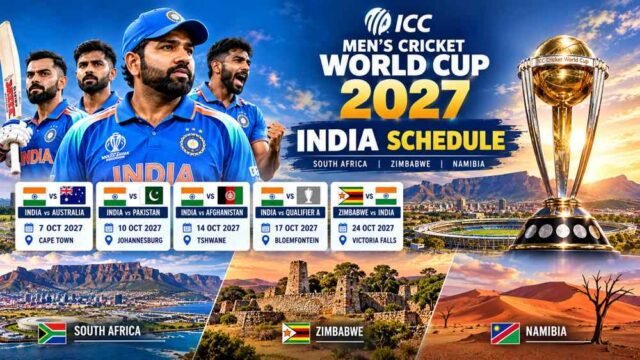
The ICC confirmed the schedule on 1 October: India open against defending champions Australia in Cape Town on 7 October 2027. It is the first ODI World Cup on African soil since 2003, co-hosted by South Africa, Zimbabwe and Namibia, with 14 teams playing 54 matches across 12 venues over seven weeks.
The draw has already handed cricket a blockbuster. India and Pakistan are in the same group. Australia, the defending champions, face both of them in the Super Six stage if all three advance. South Africa play at home with a point to prove after decades of knockout heartbreak. And for the first time, the tournament returns to the format that made the 2003 edition so memorable: two groups of seven, a Super Six stage, semi-finals and a final.
With squads not yet finalised and a full year of cricket still to play, prediction models are already crunching the early numbers. Here is what they see.
India: the Model’s Pick, Again
India have dominated white-ball cricket for the past three years. They won the T20 World Cup in 2024 and again in 2026, going unbeaten through the entire tournament on home soil. Their ODI record is just as strong. They reached the 2023 World Cup final and have the deepest batting lineup and the most complete bowling attack in the format.
Models that simulate the tournament thousands of times currently place India between 28% and 35% to win. That is the highest of any team, but it still means they lose roughly two out of three simulated tournaments. The opening game against Australia in Cape Town is a statement fixture, and the group-stage clash with Pakistan adds pressure that no model fully captures.
Australia: Defending Champions With Questions
Australia won the 2023 World Cup by beating India in the final in Ahmedabad, a result almost nobody predicted. They have the players and the pedigree. Pat Cummins is still leading the attack, and their middle order has consistently delivered in pressure situations.
The question is age. Several key players from the 2023 squad will be two years older by October 2027, and Australia’s recent ODI form has been uneven. Models rate them as the second or third most likely winner, typically around 15% to 20%, with conditions in South Africa suiting their pace attack.
South Africa: Home Advantage, Tournament Curse
South Africa are the great “what if” of World Cup cricket. They have never won the tournament, despite producing some of the finest players and teams in the sport’s history. Hosting changes things. Their bowlers know the conditions, their crowds will be loud, and the altitude in Johannesburg and the swing in Cape Town are home comforts no visiting side can replicate.
The models give South Africa a bump for home advantage, typically 12% to 18%, but they also factor in the historical knockout record, which pulls the number back down. If there is one tournament where that curse breaks, this is it.
England, New Zealand and Pakistan: The Spoilers
England won the 2019 World Cup at home and have the batting firepower to chase any total. Their record in South Africa is mixed, and much depends on which generation of players is selected.
New Zealand reached the 2023 semi-finals and the 2019 final. They never have the deepest squad, but they always find a way to compete deep into a tournament. The smaller grounds in Zimbabwe may suit their style.
Pakistan are in India’s group, which guarantees at least one fixture the whole cricket world will stop for. Their ceiling in an ODI World Cup is a title win. Their floor is a group-stage exit. The models reflect both extremes, and the average lands them around 8% to 12%.
How AI Models Forecast a World Cup Winner
The models work by feeding in each team’s recent ODI form, individual player statistics (batting averages, strike rates, bowling economy, fielding metrics), venue data and historical head-to-head records. They then simulate every group game and knockout match thousands of times, adjusting for toss outcomes, conditions and squad availability.
The output is a probability distribution, not a single prediction. India might win in 32% of simulations, Australia in 17%, South Africa in 15%, and so on. The percentages tell you how the odds are spread, not who will definitely lift the trophy.
Fans who want to track how these probabilities shift as the tournament approaches can follow AI betting tips for cricket on Betting Tips AI, which publishes model-based predictions for international fixtures with a pick, a most likely score and the data behind it. As squads are confirmed and warm-up results come in, the numbers tighten.
The Qualified Teams
| Route | Teams | Confirmed |
| Hosts | South Africa, Zimbabwe | Yes |
| 2023 World Cup top finishers + ICC ODI Rankings | India, Australia, England, New Zealand, Pakistan, Afghanistan, Bangladesh, Sri Lanka | Yes |
| 2027 World Cup Qualifier | 4 spots remaining | Feb-Mar 2027 |
Ten of the fourteen spots are filled. The remaining four will come from the 2027 World Cup Qualifier, expected in February and March 2027.
A Year Is a Long Time in Cricket
Twelve months of international cricket reshapes everything. New players emerge from the IPL, the PSL, the Hundred and domestic circuits every season. Injuries change squads. Coaches move on. The ICC ODI rankings in September 2027 will look different from the rankings today.
What the models do well is identify the structural advantages that tend to persist: India’s depth across all three departments, Australia’s big-game temperament, South Africa’s home conditions. What they cannot do is predict a 21-year-old who has not yet played a World Cup becoming the player of the tournament. That happens regularly, and it is why cricket keeps producing results that surprise everyone except the teams involved.
For the latest fixtures, standings and player statistics, the ICC’s official tournament page remains the most reliable source.
Early Verdict
India are the side to beat, and the numbers agree with what most people watching cricket would say. Australia and South Africa look the likeliest to get in their way, the hosts with the crowds and conditions on their side, the champions with the habit of winning finals.
Pakistan could go anywhere from champions to out in the group stage, and England and New Zealand shouldn’t be written off. A year out, though, nobody can say much more than that. Squads will change, and a World Cup tends to hinge on a single bad session or a dropped catch in a semi-final.
Frequently Asked Questions
Who won the last Cricket World Cup?
Australia won the 2023 ODI World Cup, beating India in the final in Ahmedabad.
When is the next Cricket World Cup?
The 2027 ICC Men’s Cricket World Cup runs from 4 October to 21 November 2027, co-hosted by South Africa, Zimbabwe and Namibia.
Which teams have qualified for the 2027 World Cup?
Ten teams are confirmed: South Africa, Zimbabwe (hosts), India, Australia, England, New Zealand, Pakistan, Afghanistan, Bangladesh and Sri Lanka. Four more spots will be decided through the 2027 World Cup Qualifier.
Can AI accurately predict a Cricket World Cup winner?
AI models estimate probabilities, not certainties. They identify favourites more consistently than gut feeling, but cricket’s variance means upsets are common. No model gives any team more than about 35%.