

List of Double Centuries in ODIs: Complete Player Guide

For the first 39 years of men’s One Day International cricket, nobody scored 200 in an innings. Then Sachin Tendulkar did it in February 2010, and the thing that had looked impossible turned out to be merely difficult. Fourteen men’s ODI double centuries have now been scored by eleven batters — and six of those fourteen have come in the last four years.
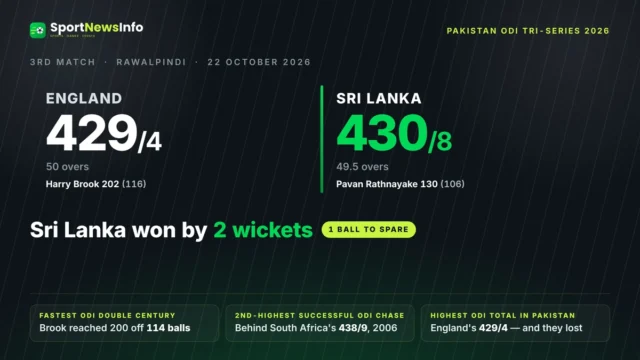
The most recent arrived today. Harry Brook made 202 off 114 balls for England against Sri Lanka at Rawalpindi on 22 October 2026, which is now the fastest double century in men’s ODI history. It broke a record that Shubman Gill had set 22 days earlier.
This guide lists every verified men’s ODI double century with the innings detail, identifies the highest and fastest, covers India’s unusually large share of them, and deals with women’s ODI double centuries in a separate section — because they are a separate record category, and merging the two is the commonest error in articles on this subject. All statistics here are verified to 22 October 2026.
What Is a Double Century in ODI Cricket?
A double century in ODI cricket means one batter scoring 200 or more runs in a single innings. There is nothing more to the definition — but there is a great deal to the difficulty.
An ODI innings is capped at 50 overs, which is 300 legal deliveries for the entire team. A batter who wants 200 of those runs has to solve three problems at once.
They need an enormous share of the deliveries. Every double centurion on the list below faced at least 114 balls — roughly 38% of the innings — and most faced close to half of it. That is only realistic if the batter is still there at the end, which means surviving the new ball, the middle overs and the death.
They need to score at a high rate while doing it. Occupying 150 balls for 140 runs is a good ODI innings; occupying 150 balls for 200 is a different order of achievement. Every innings on this list came at a strike rate above 125, and the quickest came at better than 175.
And they need partners. A batter cannot face half the innings if wickets keep falling at the other end — a new batter has to take strike, play out an over, get in. The double centuries below were almost all built on at least one very large partnership. Gill’s 223 not out, for instance, came alongside a 255-run opening stand with Rohit Sharma.
Add the obvious fourth factor — a surface and a ground where 400 is a plausible team total — and you have a list of fourteen innings across 16 years rather than a routine occurrence.
Complete List of Men’s ODI Double Centuries
This table covers men’s ODI cricket only. Women’s ODI double centuries are a separate record set and appear further down. Entries are sorted oldest first, and balls faced refers to the full innings, not the balls taken to reach 200.
| No. | Player | Team | Runs | Balls | Opponent | Match Date | Venue |
|---|---|---|---|---|---|---|---|
| 1 | Sachin Tendulkar | India | 200* | 147 | South Africa | 24 Feb 2010 | Captain Roop Singh Stadium, Gwalior |
| 2 | Virender Sehwag | India | 219 | 149 | West Indies | 8 Dec 2011 | Holkar Stadium, Indore |
| 3 | Rohit Sharma | India | 209 | 158 | Australia | 2 Nov 2013 | M Chinnaswamy Stadium, Bengaluru |
| 4 | Rohit Sharma | India | 264 | 173 | Sri Lanka | 13 Nov 2014 | Eden Gardens, Kolkata |
| 5 | Chris Gayle | West Indies | 215 | 147 | Zimbabwe | 24 Feb 2015 | Manuka Oval, Canberra |
| 6 | Martin Guptill | New Zealand | 237* | 163 | West Indies | 21 Mar 2015 | Westpac Stadium, Wellington |
| 7 | Rohit Sharma | India | 208* | 153 | Sri Lanka | 13 Dec 2017 | PCA Stadium, Mohali |
| 8 | Fakhar Zaman | Pakistan | 210* | 156 | Zimbabwe | 20 Jul 2018 | Queens Sports Club, Bulawayo |
| 9 | Ishan Kishan | India | 210 | 131 | Bangladesh | 10 Dec 2022 | Zohur Ahmed Chowdhury Stadium, Chattogram |
| 10 | Shubman Gill | India | 208 | 149 | New Zealand | 18 Jan 2023 | Rajiv Gandhi International Stadium, Hyderabad |
| 11 | Glenn Maxwell | Australia | 201* | 128 | Afghanistan | 7 Nov 2023 | Wankhede Stadium, Mumbai |
| 12 | Pathum Nissanka | Sri Lanka | 210* | 139 | Afghanistan | 9 Feb 2024 | Pallekele International Cricket Stadium |
| 13 | Shubman Gill | India | 223* | 133 | West Indies | 30 Sep 2026 | Barsapara Cricket Stadium, Guwahati |
| 14 | Harry Brook | England | 202 | 114 | Sri Lanka | 22 Oct 2026 | Rawalpindi Cricket Stadium |
14 innings by 11 batters, verified to 22 October 2026. An asterisk denotes not out.
A note on counting, because this is where published lists most often go wrong: fourteen is the number of innings, eleven is the number of players. Rohit Sharma appears three times and Shubman Gill twice. Several widely syndicated lists give twelve or thirteen innings — usually by omitting Ishan Kishan’s 210, or by predating the two 2026 entries.
The pace is changing
Look at the dates rather than the names. The first eight double centuries took from February 2010 to July 2018 — eight innings in eight and a half years. Then came a three-and-a-half-year gap with none at all, and since December 2022 there have been six in under four years.
Two of those six arrived in the last four weeks. That is the clearest signal in the whole table: the ceiling that made 200 remarkable in 2010 is not where it was.
First Double Century in Men’s ODI Cricket
Sachin Tendulkar, 200 not out off 147 balls against South Africa at the Captain Roop Singh Stadium in Gwalior on 24 February 2010, with 25 fours and three sixes.
The significance is easiest to see from the other direction. Men’s ODI cricket began in 1971. In the 39 years before Tendulkar’s innings, the highest individual score had crept up through the 180s and 190s and stopped — Saeed Anwar’s 194, Charles Coventry’s 194 not out, several innings in the high 180s. The 200 barrier had acquired the status of a structural limit rather than a target, and a generation of commentary had treated it that way.
Tendulkar was 36 when he removed it. Within 21 months Virender Sehwag had scored 219, and within five years there were six double centuries on the books. That is the usual pattern with barriers of this kind: the hard part is the first one.
One important clarification. Tendulkar’s innings was the first double century in men’s ODI cricket. It was not the first in ODI cricket. Belinda Clark had scored 229 not out in a Women’s ODI more than twelve years earlier, in December 1997 — covered in its own section below.
Highest Individual Score in Men’s ODI Cricket
Rohit Sharma’s 264 for India against Sri Lanka at Eden Gardens, Kolkata, on 13 November 2014 remains the record, and it is not close.
| Player | Rohit Sharma (India) |
|---|---|
| Runs | 264 |
| Balls faced | 173 |
| Fours | 33 |
| Sixes | 9 |
| Strike rate | 152.60 |
| Opponent | Sri Lanka |
| Venue | Eden Gardens, Kolkata |
| Date | 13 November 2014 |
What makes 264 statistically remarkable is not the strike rate, which several innings on this list beat. It is the combination of volume and duration. Rohit faced 173 balls — more than any other double centurion — and still scored at better than a run and a half per ball throughout. He reached 200 off 151 deliveries and then added 64 more runs in 22 balls.
Put it next to the rest of the table and the gap is stark: 264 is 27 runs clear of Martin Guptill’s 237 not out in second place, and 41 clear of third. Twelve years on, nobody has come within 25 runs of it.
Top five men’s ODI scores
| Rank | Score | Player | Team | Opponent | Date |
|---|---|---|---|---|---|
| 1 | 264 | Rohit Sharma | India | Sri Lanka | 13 Nov 2014 |
| 2 | 237* | Martin Guptill | New Zealand | West Indies | 21 Mar 2015 |
| 3 | 223* | Shubman Gill | India | West Indies | 30 Sep 2026 |
| 4 | 219 | Virender Sehwag | India | West Indies | 8 Dec 2011 |
| 5 | 215 | Chris Gayle | West Indies | Zimbabwe | 24 Feb 2015 |
Players With Multiple ODI Double Centuries
| Player | Team | Double Centuries | Scores |
|---|---|---|---|
| Rohit Sharma | India | 3 | 264, 209, 208* |
| Shubman Gill | India | 2 | 223*, 208 |
Only two batters have done it more than once, and both are Indian openers.
Rohit Sharma’s three is the record, and the spread is what stands out — November 2013, November 2014 and December 2017, against Australia and twice against Sri Lanka. Nine other men have managed one each. Rohit also holds the highest score and, with three innings of 208 or more, has the deepest claim on this particular record of anyone in the game’s history.
Shubman Gill’s two came three and a half years apart, and the second one changed several records at once. He is also the only batter to appear in both the top five scores and the top two fastest, which is an unusual combination: the fastest innings tend not to be the biggest.
Fastest Double Centuries in ODI Cricket
This is the ranking that needs a word of explanation first, because it is not the same thing as the shortest innings.
The fastest double century is measured by the number of balls a batter took to reach 200, not by the length of the completed innings. The two diverge, sometimes sharply. Rohit Sharma’s 264 took 173 balls in total but he was on 200 after 151 of them. Martin Guptill’s 237 not out ran to 163 balls, with 200 reached off 152. Measuring by final innings length would rank those innings quite differently — and wrongly.
| Rank | Player | Team | Balls to 200 | Final score | Opponent | Match Date |
|---|---|---|---|---|---|---|
| 1 | Harry Brook | England | 114 | 202 | Sri Lanka | 22 Oct 2026 |
| 2 | Shubman Gill | India | 117 | 223* | West Indies | 30 Sep 2026 |
| 3 | Ishan Kishan | India | 126 | 210 | Bangladesh | 10 Dec 2022 |
| 4 | Glenn Maxwell | Australia | 128 | 201* | Afghanistan | 7 Nov 2023 |
| 5 | Pathum Nissanka | Sri Lanka | 136 | 210* | Afghanistan | 9 Feb 2024 |
| 6 | Chris Gayle | West Indies | 138 | 215 | Zimbabwe | 24 Feb 2015 |
| 7 | Virender Sehwag | India | 140 | 219 | West Indies | 8 Dec 2011 |
| 8 | Shubman Gill | India | 145 | 208 | New Zealand | 18 Jan 2023 |
| 9 | Sachin Tendulkar | India | 147 | 200* | South Africa | 24 Feb 2010 |
| 10 | Fakhar Zaman | Pakistan | 148 | 210* | Zimbabwe | 20 Jul 2018 |
| 11= | Rohit Sharma | India | 151 | 264 | Sri Lanka | 13 Nov 2014 |
| 11= | Rohit Sharma | India | 151 | 208* | Sri Lanka | 13 Dec 2017 |
| 13 | Martin Guptill | New Zealand | 152 | 237* | West Indies | 21 Mar 2015 |
| 14 | Rohit Sharma | India | 156 | 209 | Australia | 2 Nov 2013 |
Complete ranking of all 14 men’s ODI double centuries by balls taken to reach 200.
The top of this table was rewritten twice in 22 days. Harry Brook’s 114 balls on 22 October 2026 displaced Shubman Gill’s 117 from 30 September, which had itself displaced Ishan Kishan’s four-year-old mark of 126. Before Kishan, the record had stood at Gayle’s 138 for seven years.
Notice also what the two lists do not share. Rohit Sharma holds the highest score and appears three times in the bottom four of the speed ranking. Tendulkar’s 200 not out — the innings that started all of this — ranks ninth of fourteen for pace. Being the biggest and being the quickest are close to unrelated achievements in this format.
Indian Players Who Have Scored ODI Double Centuries
India account for eight of the fourteen men’s ODI double centuries, scored by five batters.
| Player | Score | Balls | Opponent | Match Date | Notable |
|---|---|---|---|---|---|
| Sachin Tendulkar | 200* | 147 | South Africa | 24 Feb 2010 | First in men’s ODI history |
| Virender Sehwag | 219 | 149 | West Indies | 8 Dec 2011 | Fourth-highest men’s ODI score |
| Rohit Sharma | 209 | 158 | Australia | 2 Nov 2013 | First of his three |
| Rohit Sharma | 264 | 173 | Sri Lanka | 13 Nov 2014 | Highest men’s ODI score |
| Rohit Sharma | 208* | 153 | Sri Lanka | 13 Dec 2017 | Third double century, a record |
| Ishan Kishan | 210 | 131 | Bangladesh | 10 Dec 2022 | Fastest at the time, 126 balls |
| Shubman Gill | 208 | 149 | New Zealand | 18 Jan 2023 | His first |
| Shubman Gill | 223* | 133 | West Indies | 30 Sep 2026 | Highest score in an ODI chase |
Two of those innings deserve a closer look.
Ishan Kishan’s 210 off 131 balls against Bangladesh at Chattogram, with 24 fours and ten sixes, was the fastest men’s ODI double century for almost four years. It came in a dead rubber India had already lost the series in, which is part of why it is the most overlooked innings on the list. India made 409 for 8 and won by 227 runs.
Shubman Gill’s 223 not out off 133 balls at Guwahati is, in context, arguably the most extraordinary innings here. West Indies had made 405 for 7. India chased it down in 43.3 overs for the loss of two wickets — the highest successful run chase in ODI history, and only the second time a side has chased 400. Gill’s innings set the record for the highest individual score in an ODI run chase, passing Glenn Maxwell’s 201 not out, and he and Rohit Sharma put on 255 for the opening wicket off 158 balls.
India’s share of this record is substantial, and the structural reasons are not mysterious: a long run of high-scoring home surfaces, a settled top order with openers who bat deep, and a volume of ODI cricket few other sides play. It is a genuine achievement rather than a quirk, but it is also not evidence that Indian batters are better suited to the feat than anyone else — Brook and Gill scored theirs within four weeks of each other on opposite sides of the world.
Women’s ODI Double Centuries
Women’s ODI records are a separate category from men’s ODI records, and the two should never be ranked in a single unlabelled table. The innings below are not part of the fourteen listed above.
There are exactly two double centuries in Women’s ODI cricket, verified to 22 October 2026.
| Player | Team | Runs | Balls | Opponent | Match Date | Venue |
|---|---|---|---|---|---|---|
| Belinda Clark | Australia | 229* | 155 | Denmark | 16 Dec 1997 | MIG Club Ground, Mumbai |
| Amelia Kerr | New Zealand | 232* | 145 | Ireland | 13 Jun 2018 | Castle Avenue, Dublin |
Belinda Clark’s 229 not out came in a 1997 World Cup match in Mumbai, and it is the innings that history tends to mislay. It was the first double century in any form of One Day International cricket — men’s or women’s — and it came twelve years and two months before Tendulkar’s 200 not out. Any article that calls Tendulkar’s innings “the first ODI double century” without the word “men’s” is simply wrong, and a great many do.
Amelia Kerr’s 232 not out against Ireland in Dublin is the highest individual score in Women’s ODI cricket, and the circumstances are hard to better. She was 17 years old — the youngest cricketer of either gender to score an ODI double century — and in the same match she took five wickets for 17 runs, her first five-wicket haul in the format. A double century and a five-for in one ODI is a combination with no real parallel.
For readers who want the cross-category comparison, stated clearly as such: taking men’s and women’s ODIs together, the highest individual scores are Rohit Sharma’s 264, Guptill’s 237 not out, Kerr’s 232 not out, Clark’s 229 not out and Gill’s 223 not out. That is a combined list and is presented only as a point of interest; the record books keep the two categories apart, and so does this guide.
How Rare Is a Double Century in ODI Cricket?
Rare enough that fourteen innings cover the whole history of men’s ODI cricket, and common enough now that two have happened in the last month. Both halves of that sentence are true, and the reason sits in the format’s arithmetic.
The 50-over limit is the binding constraint. There are 300 legal balls in an innings. A batter chasing 200 needs somewhere between 110 and 175 of them, which is a third to well over half the team’s entire allocation. In Test cricket a batter can bat for two days; here they have a hard ceiling, and the only way to get the volume is to open and survive.
Which is why openers dominate the list. Twelve of the fourteen double centurions were opening the batting. Only Glenn Maxwell and Harry Brook managed it from further down the order — Brook being, by one published count, the second non-opener to do so. Coming in at four or five, you simply cannot face enough deliveries.
Strike rate and running both matter, not just hitting. It is tempting to read these innings as pure boundary-hitting, and the numbers do not support that. Rohit’s 264 contained 33 fours and nine sixes — 186 runs in boundaries, meaning 78 came from running. Brook’s 202 had 21 fours and ten sixes. Even the most violent of these innings involve a great deal of ones and twos between the big shots.
Partnerships are a precondition, not a detail. No batter faces half an innings while wickets tumble. Gill’s 255-run opening stand with Rohit at Guwahati is the clearest example on the list.
And then there is what has changed. Six of the fourteen have come since December 2022, in an era of higher team totals, flatter surfaces in several countries, and batters who have brought T20 scoring rates into the 50-over game. The reason 200 looked like a limit in 2010 was not that it was impossible — it was that nobody had yet built an innings designed to get there.
Key Records and Interesting Facts
All records verified to 22 October 2026. Each is labelled by category.
| Record | Holder | Detail |
|---|---|---|
| Highest individual score, men’s ODI | Rohit Sharma (India) | 264 off 173 v Sri Lanka, Kolkata, 13 Nov 2014 |
| First double century, men’s ODI | Sachin Tendulkar (India) | 200* off 147 v South Africa, Gwalior, 24 Feb 2010 |
| First double century, any ODI | Belinda Clark (Australia) | 229* off 155 v Denmark, Mumbai, 16 Dec 1997 — Women’s ODI |
| Fastest double century, men’s ODI | Harry Brook (England) | 200 off 114 balls v Sri Lanka, Rawalpindi, 22 Oct 2026 |
| Most double centuries, men’s ODI | Rohit Sharma (India) | 3 — 264, 209, 208* |
| Highest score in an ODI run chase | Shubman Gill (India) | 223* off 133 v West Indies, Guwahati, 30 Sep 2026 |
| Highest individual score, Women’s ODI | Amelia Kerr (New Zealand) | 232* off 145 v Ireland, Dublin, 13 Jun 2018 |
| Youngest double centurion, any ODI | Amelia Kerr (New Zealand) | Aged 17, in the same match as a five-wicket haul (5/17) |
| Most recent, men’s ODI | Harry Brook (England) | 202 off 114, 22 Oct 2026 — England’s first and highest |
| Indian double centuries, men’s ODI | Five batters | 8 of the 14 innings |
| Total, men’s ODI | — | 14 innings by 11 batters |
| Total, Women’s ODI | — | 2 innings by 2 batters |
A few additional details worth knowing. Harry Brook’s innings was the first ODI double century by an England batter and England’s highest individual ODI score, passing Ben Stokes’ 182; England’s 429 for 4 in that match is also the highest ODI total made in Pakistan. Glenn Maxwell’s 201 not out against Afghanistan came at the 2023 World Cup and was the first by a batter not opening the innings. And Martin Guptill’s 237 not out, which stood as the second-highest score for eleven years, was made in a World Cup quarter-final.
Frequently Asked Questions
Who scored the first double century in men’s ODI cricket?
Sachin Tendulkar, with 200 not out off 147 balls for India against South Africa at Gwalior on 24 February 2010. It was the first time any batter had reached 200 in a men’s ODI innings in the format’s 39-year history to that point.
Who holds the highest individual score in men’s ODI cricket?
Rohit Sharma, with 264 off 173 balls against Sri Lanka at Eden Gardens, Kolkata, on 13 November 2014. He hit 33 fours and nine sixes at a strike rate of 152.60. The score remains 27 runs clear of second place after twelve years.
How many players have scored double centuries in men’s ODIs?
Eleven batters have scored a total of fourteen men’s ODI double centuries, verified to 22 October 2026. The figures differ because Rohit Sharma has three and Shubman Gill two. Many published lists are out of date or omit an innings.
Who has scored the most double centuries in men’s ODI cricket?
Rohit Sharma, with three: 264 against Sri Lanka in 2014, 209 against Australia in 2013 and 208 not out against Sri Lanka in 2017. Shubman Gill is the only other batter with more than one, having scored two.
Who scored the fastest double century in men’s ODI cricket?
Harry Brook of England, who reached 200 off 114 balls against Sri Lanka at Rawalpindi on 22 October 2026, finishing with 202. He broke Shubman Gill’s 117-ball record, which had been set only 22 days earlier.
Which Indian players have scored ODI double centuries?
Five: Sachin Tendulkar (200*), Virender Sehwag (219), Rohit Sharma (264, 209 and 208*), Ishan Kishan (210) and Shubman Gill (223* and 208). Together they account for eight of the fourteen men’s ODI double centuries.
Are women’s ODI double centuries included in men’s ODI records?
No. They are separate record categories and are not ranked together. There are two Women’s ODI double centuries — Belinda Clark’s 229 not out in 1997 and Amelia Kerr’s 232 not out in 2018 — and neither appears in men’s ODI record lists.
What is a double century in ODI cricket?
An individual batter scoring 200 or more runs in a single One Day International innings. Because an innings is capped at 50 overs, the batter must face roughly a third to a half of the team’s 300 deliveries while scoring at a high rate throughout.
How many balls did the highest-scoring batter face?
Rohit Sharma faced 173 balls for his record 264 — more than any other double centurion. He reached 200 off 151 deliveries and then added 64 runs from his last 22 balls.
Where can readers verify the complete ODI double-century list?
The ESPNcricinfo records section and the ICC website carry official scorecards and record tables, and national boards publish match records. Because records change, check the cutoff date on any list you consult — several major pages were out of date when this guide was written.
A Record That Will Not Sit Still
Writing a guide to ODI double centuries in October 2026 is an awkward business, because the subject keeps moving. The fastest-200 record has changed hands twice in the past month. Six of the fourteen innings have been scored in under four years. A list that was accurate in July was wrong by the end of September, and wrong again by today.
What has not changed is the shape of the achievement. A batter still needs to open, survive the new ball, face roughly half the innings and score at a rate that would have been thought reckless in 2010. Rohit Sharma’s 264 still looks untouchable, and Belinda Clark still got there first, twelve years before anyone in the men’s game.
Records on this page are verified to 22 October 2026 and will be updated as new innings are played. Follow our cricket section for records coverage, match reports and full scorecards.
Published: 22 October 2026. Records cutoff: 22 October 2026. Every innings in the tables above was checked against published scorecards and record databases, and the men’s and women’s record sets are kept separate throughout. Where sources disagreed — on Harry Brook’s ball count and on the total number of qualifying innings — the discrepancy was resolved against the more complete source and is noted in our editorial record.
1 comment
Comments are closed on this article.