

New Zealand vs India 1st ODI: Kohli Passes Tendulkar’s Chase Record in Five-Wicket Win
India beat New Zealand by five wickets (DLS) at Eden Park, chasing a revised 143 with 56 balls to spare. Virat Kohli's 74 off 51 took him past Sachin Tendulkar as the leading run-scorer in ODI chases.
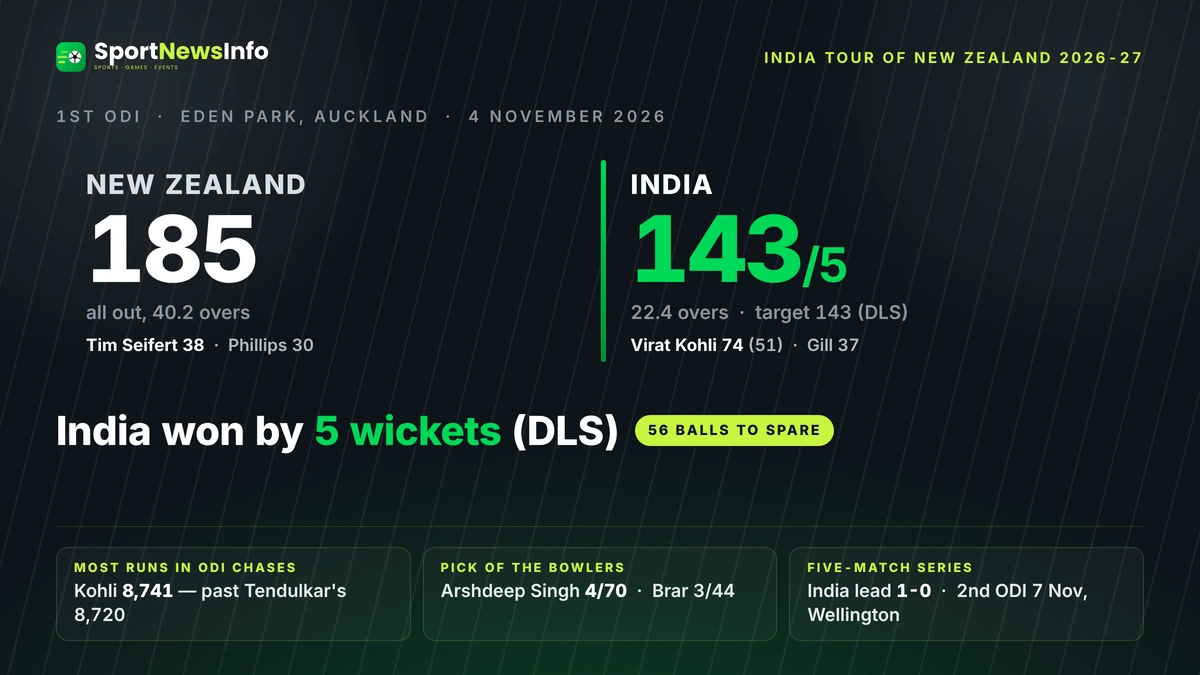
New Zealand vs India 1st ODI 2026: Kohli Passes Tendulkar as ODI Cricket’s Greatest Chaser
India beat New Zealand by five wickets under the DLS method at Eden Park on Wednesday, chasing a revised target of 143 in 32 overs with 56 balls to spare. Virat Kohli made 74 from 51 balls and, in doing so, passed Sachin Tendulkar as the leading run-scorer in ODI run chases.
New Zealand were bowled out for 185 in 40.2 overs after Shubman Gill won the toss and chose to field. Rain then cut the match short, and the revised target never looked like troubling India. They lead the five-match series 1-0.
New Zealand vs India 1st ODI – Match Summary
| Match | New Zealand vs India, 1st ODI |
|---|---|
| Series | India tour of New Zealand 2026-27 |
| Date | 4 November 2026 |
| Venue | Eden Park, Auckland |
| Toss | India won and chose to field |
| New Zealand | 185 all out in 40.2 overs |
| India’s revised target | 143 in 32 overs (DLS) |
| India | 143 for 5 in 22.4 overs |
| Result | India won by 5 wickets (DLS), with 56 balls remaining |
| Series status | India lead 1-0 |
Kohli Passes Tendulkar as the Greatest Chaser in ODI History
The number that outlasts this match is 8,741.
Virat Kohli’s 74 took his career tally in ODI run chases past Sachin Tendulkar’s 8,720, a mark that had stood as the benchmark for batting second in one-day cricket. Kohli now has 8,741.
It is a record that fits him more neatly than almost any other. Chasing is the discipline that rewards pacing an innings against a known number, and Kohli has built two decades of batting around exactly that problem. He reached 74 from 51 balls here with thirteen fours and a six — a strike rate above 145, which is not how these innings usually look, and a reminder that the revised target left no room for the slow accumulation he is better known for.
India’s Bowlers Set It Up
New Zealand never built a platform. Will Young fell for 9 to Arshdeep Singh inside the sixth over, and the innings that followed was a sequence of starts rather than scores.
Tim Seifert top-scored with 38, playing in place of Devon Conway, who was ruled out with concussion. Glenn Phillips made 30. Nobody else passed that, and New Zealand were dismissed for 185 with nearly ten overs of their allocation unused.
India’s seamers did the damage and the breakdown is worth reading closely:
- Arshdeep Singh — 4 for 70. The wickets came at a cost, but four of them on a surface offering bounce was the difference.
- Gurnoor Brar — 3 for 44.
- Anshul Kamboj — 2 for 22. The most economical spell of the innings by some distance.
Nine of the ten wickets went to those three. For a bowling group missing several first-choice names, dismissing New Zealand inside 41 overs at their own ground is a strong afternoon’s work.
Rain, DLS and a Chase That Was Never in Doubt
Rain arrived between the innings and took the game down to 32 overs a side, with India set a revised target of 143.
That is the part worth being precise about, because a five-wicket margin can read closer than it was. India reached 143 for 5 in 22.4 overs — nine and a third overs unused, 56 balls in hand. Shubman Gill made 37 in support of Kohli, and the pair took the chase beyond New Zealand’s reach before the lower order was needed.
Eden Park’s short straight boundaries, which made the T20I here such a run-fest, worked for the chasing side again.
Key Statistics
| Player | Team | Performance |
|---|---|---|
| Virat Kohli | India | 74 off 51 (13 fours, 1 six) |
| Arshdeep Singh | India | 4 for 70 |
| Gurnoor Brar | India | 3 for 44 |
| Shubman Gill | India | 37 |
| Tim Seifert | New Zealand | 38 (top score) |
| Glenn Phillips | New Zealand | 30 |
| Anshul Kamboj | India | 2 for 22 |
What It Means for the Series
India lead 1-0 with four to play. The context that makes this more interesting than a routine opener is that New Zealand had just won the last two T20Is of the preceding series, taking some momentum into the one-day leg — and then lost the first match of it inside 63 overs of cricket.
Both sides are also managing squads with a World Cup in view. New Zealand are without Devon Conway, Mark Chapman and Rachin Ravindra; India have handed overs to Gurnoor Brar, Anshul Kamboj and Auqib Nabi rather than their first-choice attack. A 1-0 lead earned by three of those bowlers is a useful answer to the selection question.
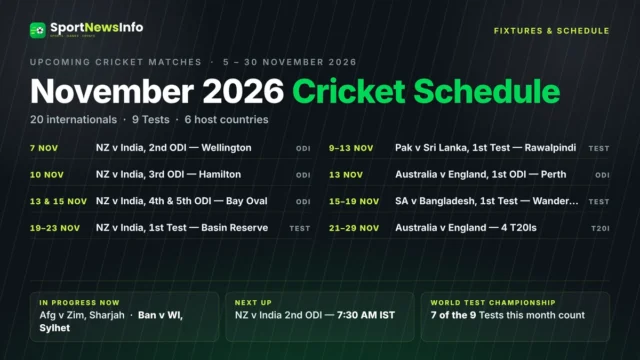
The second ODI is on Saturday 7 November at Hnry Stadium, Wellington, starting at 7:30 AM IST.
Frequently Asked Questions
Who won the New Zealand vs India 1st ODI in 2026?
India won by five wickets under the DLS method at Eden Park, Auckland, on 4 November 2026, with 56 balls to spare.
What record did Virat Kohli break?
He became the highest run-scorer in ODI run chases, passing Sachin Tendulkar’s 8,720 runs. Kohli now has 8,741.
How many runs did Virat Kohli score?
74 from 51 balls, with thirteen fours and a six.
What was New Zealand’s score?
185 all out in 40.2 overs. Tim Seifert top-scored with 38 and Glenn Phillips made 30.
What was India’s DLS target?
Rain reduced the match to 32 overs a side and India were set 143. They reached 143 for 5 in 22.4 overs.
Who took the most wickets?
Arshdeep Singh, with 4 for 70. Gurnoor Brar took 3 for 44 and Anshul Kamboj 2 for 22.
When is the second India vs New Zealand ODI?
Saturday 7 November 2026 at Hnry Stadium, Wellington, at 7:30 AM IST.
Conclusion
A rain-shortened opener produced one lasting number and one useful signal. The number is Kohli’s 8,741, which makes him the most prolific chaser the one-day game has had. The signal is that an India attack built around Arshdeep Singh, Gurnoor Brar and Anshul Kamboj bowled New Zealand out for 185 in Auckland.
India lead 1-0. Wellington on Saturday will say more about whether that was a pattern or a wet Wednesday.


1 comment
Comments are closed on this article.