

Why Bhuvneshwar Kumar Is Back in India’s T20I Squad After Four Years
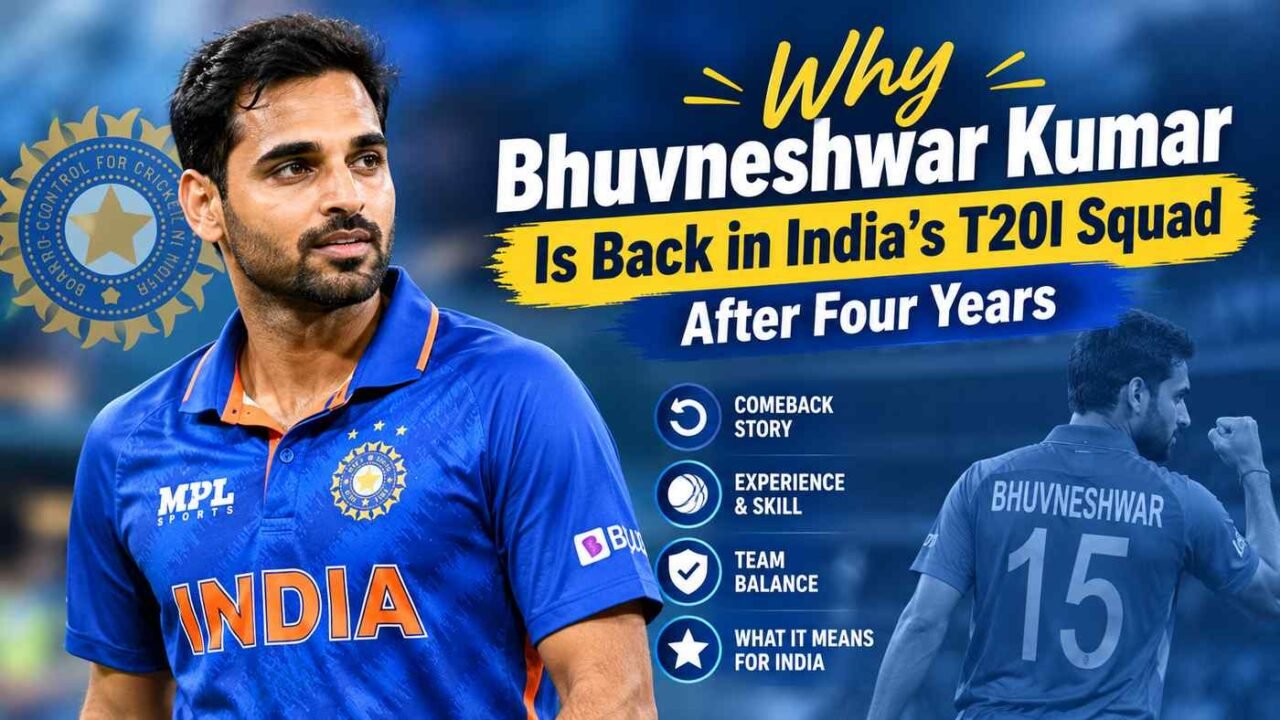
On 22 November 2022, Bhuvneshwar Kumar bowled in a rain-shortened T20I against New Zealand at McLean Park in Napier. The match was tied on DLS. He was 32, he had just had an expensive T20 World Cup, and nobody announced anything — but that was the end of his India career.
Three years and eleven months later, he is in the squad for a T20I series against New Zealand, in New Zealand, with the first match on Thursday at Hagley Oval. He is 36 years old. He has not played an international match of any kind since January 2022 in ODIs and that November night in Napier in T20Is.
So what changed? Two things, and only one of them is about Bhuvneshwar.
The first answer: an IPL season that was impossible to argue with
Bhuvneshwar’s IPL 2026 for Royal Challengers Bengaluru was not a nostalgic flicker. It was, by volume, the best season of his career.
| Season | Team | Matches | Wickets | Average | Economy |
|---|---|---|---|---|---|
| 2026 | RCB | 16 | 28 | 17.89 | 7.95 |
| 2017 | SRH | 14 | 26 | 14.19 | 7.05 |
| 2016 | SRH | 17 | 23 | 21.30 | 7.42 |
| 2025 | RCB | — | 17 | — | — |
He finished 2026 with 28 wickets, one behind Kagiso Rabada’s 29, which cost him what would have been a third Purple Cap after 2016 and 2017. He took two wickets in the final as RCB beat Gujarat Titans for a second consecutive title, having topped the league stage. Somewhere in the middle of it, he became the first fast bowler to take 200 wickets in the IPL.
Read the table honestly, though, because the economy column matters. His 2017 season — 26 wickets at 14.19, going at 7.05 — is still the better piece of bowling. In 2026 he took two more wickets but conceded nearly a run more per over, in a tournament where everybody concedes more than they did in 2017. What the 2026 numbers prove is not that he is the bowler he was at 27. It is that he is still taking wickets at the top and the end of an innings in the most unforgiving T20 competition there is, at 36, across two consecutive full and fit seasons. That is the part that answers the durability question that ended his India career in the first place.
He was not short of public advocates either. Ravichandran Ashwin — who, as it happens, is on Sony’s commentary panel for this very tour — said on his YouTube channel: “Bhuvneshwar Kumar is a yes. I would tell him to do all the tournaments – First Class, the Vijay Hazare – everything.” Dinesh Karthik had him in a projected squad. The conversation had been running for months.
The second answer: the man who would not pick him left the job
This is the part most coverage of the recall has skipped, and it is the more interesting half.
Look at three dates together:
| Date | What happened |
|---|---|
| 4 October 2026 | Ajit Agarkar’s tenure as India’s chief selector ends; the BCCI invites applications for the committee |
| 7 October 2026 | This T20I squad is announced. Bhuvneshwar Kumar is recalled |
| 19 October 2026 | Pragyan Ojha is confirmed as the new chair of the Men’s Selection Committee |
The squad was chosen in the three-day window after one chief selector left and almost a fortnight before his successor was formally appointed. And according to a PTI report, Agarkar “did not believe in going back to pacers closing in on retirement age” and preferred to invest in young quick bowlers.
That is a reported characterisation of his thinking rather than a quote from the man himself, and it should be read as such. But it fits what actually happened on the field for four years: Bhuvneshwar kept taking IPL wickets, and the India squad kept not including him. One report described Ojha as interim head of the committee that made this pick — he was only confirmed as chair on 19 October, after the squad was out, so treat that detail with care. What is not in doubt is that this selection was made by a committee without Agarkar in it, days after he left.
The current committee, as confirmed on 19 October, is Pragyan Ojha as chair, with Shiv Sundar Das, RP Singh, Ajay Ratra and Ramesh Powar. It is worth noting that RP Singh is a former India seamer who knows precisely what a left-armer or a swing bowler is for.
Selection philosophy is not a neutral instrument. The same player, with the same numbers, is either “a 36-year-old blocking a young quick” or “the most reliable new-ball bowler available” depending entirely on who is in the room. Bhuvneshwar’s numbers did not suddenly become good in October 2026. The room changed.
What the four years in between actually looked like
It is worth being clear that Bhuvneshwar did not disappear. He was dropped from India and then kept doing the job in front of a full house every April and May.
He had been at Sunrisers Hyderabad from 2014 to 2024 — eleven seasons, two Purple Caps, the bowler the franchise built its identity around. Then in the November 2024 auction, Royal Challengers Bengaluru paid ₹10.75 crore for him. That is not a loyalty price or a mentor’s retainer. That is a team spending top-bracket money on a 34-year-old seamer because they had decided he would win them matches, and they were right twice over: RCB took the title in 2025 with 17 wickets from him, and again in 2026 with 28.
There is something telling in that gap. For four years, the most ruthless buyers in cricket — franchise owners spending their own money with no sentiment attached — kept valuing Bhuvneshwar Kumar near the top of the market, while the national selectors did not pick him at all. Both groups were watching the same bowler. Only one of them was weighing his age more heavily than his output.
What the rest of the squad tells you about his job
You can read a selection by what surrounds it. India’s seam attack for these five T20Is is Arshdeep Singh, Mayank Yadav, Prince Yadav — and Bhuvneshwar.
Jasprit Bumrah is rested on workload grounds and is instead in the Test squad for later in the tour. Hardik Pandya is unavailable, having not regained full fitness. Ravi Bishnoi was the one player dropped, after three wicketless T20Is in Japan including the Asian Games semi-final and final, with Varun Chakaravarthy returning in his place from a side strain picked up against Afghanistan.
So India are going to New Zealand without their best fast bowler, without their first-choice seam-bowling all-rounder, and with two of their three remaining quicks being young and genuinely fast rather than controlled. Mayank Yadav and Prince Yadav bowl quick. Neither is the man you give the 19th over when the required rate is nine.
That is the gap Bhuvneshwar fills. Not pace — he has not had top-end pace for years. What he has is the ability to put the ball where he intends at both ends of an innings. Across 87 T20Is he took 90 wickets at 23.10 with an economy a shade under seven, with a best of 5 for 4 against Afghanistan in 2022. As of 2022 he was the leading wicket-taker in the powerplay in T20I history, with 34 powerplay wickets at an economy of 5.53, narrowly ahead of Samuel Badree and Tim Southee. Those are control numbers, not strike numbers.
The counterpoint nobody is printing
Every article about this recall is telling you that New Zealand’s seaming, swinging conditions are made for Bhuvneshwar Kumar. It sounds obviously right. It is also not what his record there says.
In five T20Is in New Zealand, Bhuvneshwar has taken four wickets at an average of 40, with an economy rate of 8.42.
That is a small sample and it includes the Napier match that ended his career, so do not over-read it. But it is worth putting next to the “conditions suit him” line, because the assumption deserves testing. A pitch that offers movement rewards a bowler who can hit a length; it also punishes a bowler whose pace has dropped if the ball sits up. And all five of these T20Is start at 8:00 PM local — under lights, with a white ball, on grounds where the square boundaries at Eden Park and the wind at Wellington do more to decide an over than the seam position does.
The honest position is that this is a reasonable selection with an open question attached, not a certainty.
What the selection does not mean
Here is the detail that gives the recall its real shape. India announced their ODI and Test squads for this same tour on 16 October. Bhuvneshwar Kumar is in neither.
That matters, because for most of 2026 the conversation around him was not about T20Is at all. It was about the 2027 ODI World Cup in South Africa, Zimbabwe and Namibia, where the seam-friendly conditions had analysts arguing he deserved a look. His ODI record is substantial — 121 matches, 141 wickets at 35.11, economy 5.08, best of 5 for 42 — and he took 10 wickets at the 2019 World Cup including a three-for in the semi-final against New Zealand.
He has not been picked for the ODIs. Mohammed Siraj, Arshdeep Singh, Prasidh Krishna, Anshul Kamboj and Gurnoor Brar have. So whatever this is, it is not the reopening of an ODI career or a soft start on the road to 2027.
It reads instead as a short-term, specific appointment: five T20Is, away, in conditions where control is worth more than pace, with the first-choice attack unavailable. A specialist hire for a specific job, not a succession plan.
The question the series will actually answer
Watch which overs he bowls. That is the whole thing.
If Bhuvneshwar opens the bowling and is done by the eighth over, India have picked him as a powerplay specialist — buy wickets early, let the young quicks take the back end, and accept whatever happens in the last five. That is the conservative reading and it fits his career numbers.
If he bowls the 18th or 20th over, something more interesting is going on: the team has decided that at 36 he is still their most reliable death bowler, which would say a great deal about how little they trust the alternatives in that phase.
And if he does both, India have found something they have been short of since Bumrah’s workload became a permanent planning constraint — a bowler who can be deployed at either end of an innings without a change of plan.
Four years is a long time out of a format that has changed considerably in the interval. Bhuvneshwar Kumar has earned this on the strength of 28 IPL wickets and two fit seasons, and he has been handed it by a selection committee that reads the same evidence differently from the last one. Thursday afternoon in Christchurch — 12:30 PM IST — we find out which of those two facts was doing more of the work.
Bhuvneshwar Kumar: the numbers at a glance
| Age | 36 (born 5 February 1990) |
|---|---|
| Last T20I | 22 November 2022, 3rd T20I v New Zealand, Napier — tied on DLS |
| Last ODI | January 2022, v South Africa |
| T20I career | 87 matches, 90 wickets, average 23.10, economy just under 7, best 5/4 |
| ODI career | 121 matches, 141 wickets, average 35.11, economy 5.08, best 5/42 |
| T20Is in New Zealand | 5 matches, 4 wickets, average 40.00, economy 8.42 |
| IPL 2026 | 28 wickets in 16 matches at 17.89, economy 7.95 — second on the wicket charts |
| IPL milestone | First fast bowler to 200 IPL wickets |
| IPL teams | Sunrisers Hyderabad 2014–2024; Royal Challengers Bengaluru from 2025 |
| Domestic | Uttar Pradesh |
| Selected for | T20Is only. Not in India’s ODI or Test squads for this tour |
Published: 20 October 2026. Last updated: 20 October 2026.
Sources: Career statistics from published player records and a dedicated recall explainer (7 October 2026); IPL 2026 figures and the Purple Cap outcome from end-of-season reporting (31 May 2026) and the RCB 2026 season record; selection-committee dates from BCCI reporting of 4 and 19 October 2026; squad details and the PTI characterisation of the previous chief selector’s approach from squad-announcement coverage (7 October 2026). His record in New Zealand T20Is and his 2022 powerplay record are quoted as published, with their dates given.

1 comment
Comments are closed on this article.