IND vs NZ, 1st T20I 2026: Full Scorecard, Match Result and Highlights
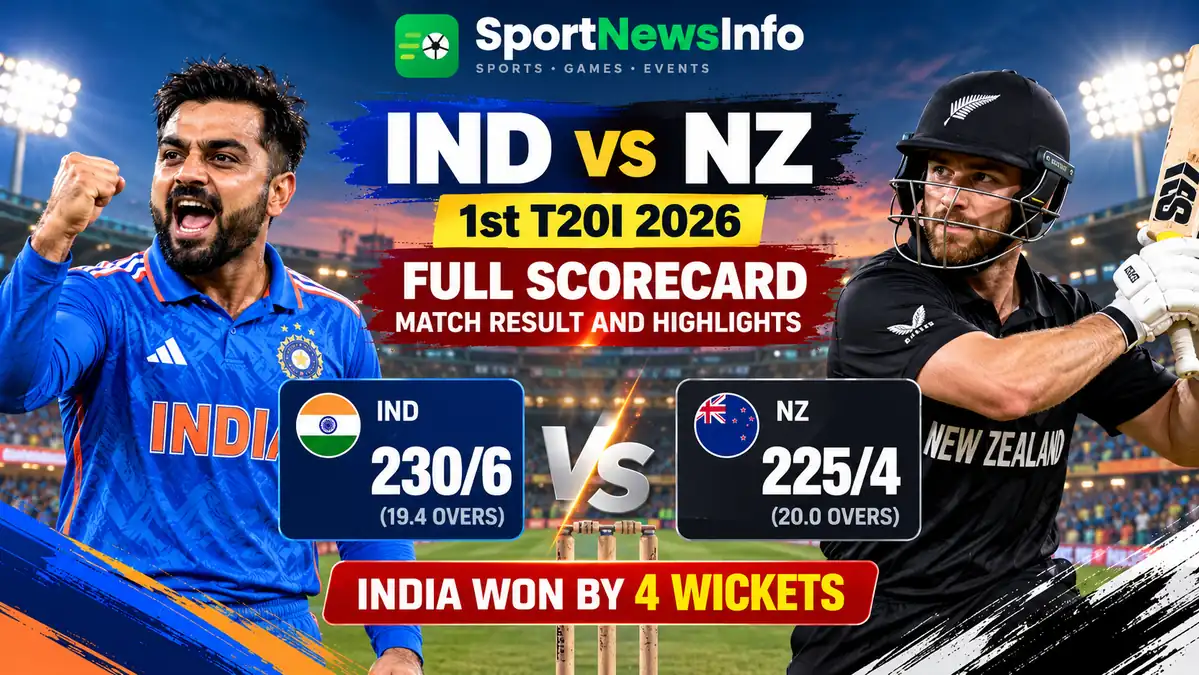
India beat New Zealand by four wickets in the first T20 International at Hagley Oval, Christchurch, on Thursday, chasing down 226 with two balls to spare. New Zealand had posted 225 for 4 — their highest T20I total on home soil — and India answered with 230 for 6 in 19.4 overs.
It was a chase that had no business being as controlled as it was. Glenn Phillips had taken the game away from India with 82 not out from 40 balls, and at a ground where the average first-innings T20 score sits around 161, New Zealand’s total looked close to decisive. Instead, Sanju Samson made 67, Shreyas Iyer 42 on his first outing as T20I captain, and Naman Dhir finished unbeaten on 42 to see India home. This IND vs NZ 1st T20I 2026 scorecard carries the full batting and bowling detail below.
India vs New Zealand 1st T20I 2026 – Match Summary
| Match | New Zealand v India, 1st T20I |
|---|---|
| Series | India tour of New Zealand, 2026-27 (five T20Is) |
| Venue | Hagley Oval, Christchurch |
| Date | Thursday, 22 October 2026 (day-night) |
| Toss | India won the toss and elected to field |
| New Zealand | 225/4 in 20 overs |
| India | 230/6 in 19.4 overs |
| Result | India won by 4 wickets (2 balls remaining) |
| Player of the Match | To be confirmed from the official scorecard |
| Umpires | Chris Brown and Shaun Haig; TV umpire Kim Cotton |
| Match referee | Ranjan Madugalle |
New Zealand Batting Scorecard
| Batter | Dismissal | Runs | Balls | 4s | 6s | SR |
|---|---|---|---|---|---|---|
| Tim Seifert (wk) | c Sanju Samson b Mayank Yadav | 24 | 17 | 3 | 1 |
141.18
|
| Finn Allen | c Tilak Varma b Axar Patel | 45 | 24 | 5 | 2 | 187.50 |
| Daryl Mitchell | to be confirmed | 28 | 19 | 2 | 1 | 147.37 |
| Glenn Phillips | not out | 82* | 40 | 8 | 3 | 205.00 |
| Bevon Jacobs | to be confirmed | 31 | 16 | — | 3 | 193.75 |
| Michael Bracewell | not out | 7* | — | 0 | 0 | — |
Extras 8. Total: 225 for 4 in 20 overs. Did not bat: Mitchell Santner (c), Nathan Smith, Matt Henry, Adam Milne, Lockie Ferguson. Balls, boundary counts and dismissal details marked “to be confirmed” are pending the official scorecard; the strike rates shown are calculated from confirmed runs and balls only.
New Zealand were asked to bat and started at a rate India never looked like containing. Tim Seifert and Finn Allen put on 49 inside the first five overs, and Allen’s 45 from 24 balls was the innings that set the tempo — a strike rate of 187 at the top of a T20 innings leaves the bowling side chasing the game from the outset.
Seifert fell for 24 and Daryl Mitchell contributed 28, but the innings belonged to Glenn Phillips. His 82 not out from 40 balls came at a strike rate just above 200, and he batted through to the final ball. Bevon Jacobs played the ideal supporting hand with 31 from 16, and Michael Bracewell was unbeaten on 7 at the close.
The total deserves its context. 225 for 4 is New Zealand’s highest T20I total at home, and it equals the 225 they made against India at Thiruvananthapuram on 1 February 2026 — their joint-highest against this opposition. It is also the second-highest T20I total ever made at Hagley Oval, behind England’s 236 for 4 in 2025. Against an average first-innings score of 161 at this ground across 15 matches, New Zealand had built something that should have won them the game.
India Bowling Scorecard
| Bowler | Overs | Maidens | Runs | Wickets | Economy |
|---|---|---|---|---|---|
| Bhuvneshwar Kumar | 4 | 0 | 49 | 0 | 12.20 |
| Arshdeep Singh | 4 | 0 | 45 | 1 | 11.20 |
| Mayank Yadav | 4 | 0 | 40 | 1 | 10 |
| Axar Patel | 4 | 0 | 51 | 1 | 12.80 |
| Nitish Kumar Reddy | 4 | 0 | 40 | 0 | 10 |
India’s full bowling analysis had not been published at the time of writing and is to be completed from the official scorecard. The six names above are the bowling options in India’s XI; who bowled, and how many overs each sent down, should be taken from the official record rather than assumed.
What can be said without the figures is that this was the first T20I of Bhuvneshwar Kumar’s return to the side after nearly four years, and that India’s seam attack of Bhuvneshwar, Arshdeep Singh and Mayank Yadav operated without Jasprit Bumrah, who is rested for the T20Is, and without Hardik Pandya, who is unavailable. Conceding 225 at a ground that usually yields around 160 is the clearest indication of how the first innings went. We will not characterise individual spells until the figures are confirmed.
India Batting Scorecard
| Batter | Dismissal | Runs | Balls | 4s | 6s | SR |
|---|---|---|---|---|---|---|
| Sanju Samson (wk) | to be confirmed | 67 | 33 | 8 | 4 |
203.03
|
| Abhishek Sharma | to be confirmed | 29 | 12 | 2 | 3 | 241.67 |
| Ishan Kishan | to be confirmed | 1 | 3 | 0 | 0 | 33.33 |
| Shreyas Iyer (c) | b Adam Milne | 42 | 28 | 1 | 2 | 150.00 |
| Tilak Varma | to be confirmed | 6 | 11 | 0 | 0 | 54.55 |
| Axar Patel | to be confirmed | 24 | 14 | 3 | 1 | 171.43 |
| Naman Dhir | not out | 42* | 15 | 5 | 2 | 280.00 |
| Nitish Kumar Reddy | not out | 2* | 3 | 0 | 0 | 66.67 |
Extras 17. Total: 230 for 6 in 19.4 overs. Did not bat: Bhuvneshwar Kumar, Arshdeep Singh, Mayank Yadav. Shreyas Iyer’s dismissal to Adam Milne is confirmed; the remaining dismissal details, balls faced and boundary counts are pending the official scorecard.
Needing 226, India’s reply was built on a top-order platform and finished by the middle order — which is unusual in a chase of this size, and is the most interesting thing about it.
Sanju Samson’s 67 was the highest score of India’s innings. Opening alongside Abhishek Sharma, who made 29, he gave the chase the start it had to have. Ishan Kishan fell for 1 and Tilak Varma for 6, which could easily have unravelled the innings at the point where the required rate was at its least forgiving.
It did not, because Shreyas Iyer made 42 before Adam Milne bowled him. That innings, on Iyer’s first assignment as T20I captain, held the chase together through the middle overs. Axar Patel’s 24 kept it moving, and then Naman Dhir finished the job with an unbeaten 42 — the innings that actually won the match — with Nitish Kumar Reddy alongside him on 2 not out when the winning runs came in the 20th over.
Worth noting too: India’s 17 extras against New Zealand’s 8. In a chase decided by two balls, a nine-run difference in the extras column is not a footnote.
New Zealand Bowling Scorecard
| Bowler | Overs | Maidens | Runs | Wickets | Economy |
|---|---|---|---|---|---|
| Matt Henry | 3.4 | 0 | 57 | 0 | 15.50 |
| Adam Milne | 3 | 0 | 43 | 1 (Shreyas Iyer) | — |
| Lockie Ferguson | 3 | 0 | 34 | 1 | — |
| Mitchell Santner (c) | 4 | 0 | 39 | 2 | — |
| Nathan Smith | 2 | 0 | 20 | 0 | — |
| Michael Bracewell | 4 | 0 | 37 | 2 | — |
New Zealand’s bowling figures had not been published at the time of writing. Adam Milne’s dismissal of Shreyas Iyer is the one wicket confirmed; the remaining five of India’s six wickets are not yet attributable, and we are not going to infer them from a fall-of-wickets list. Complete this table from the official scorecard.
How India Chased the Target
India needed 226 from 120 balls — 11.3 an over — and got there with two deliveries unused, which tells you the chase was never far from the required rate but also never comfortably ahead of it.
The opening stand between Samson and Abhishek Sharma did the heavy lifting early. The loss of Kishan for 1 and Tilak Varma for 6 was the danger point: two cheap wickets in a chase of this size usually ends the contest, because the remaining batters have to accelerate from a standing start. Iyer’s 42 absorbed that pressure, and Axar Patel’s 24 kept the equation from drifting out of reach.
Then it came down to Naman Dhir. His 42 not out closed out a chase of 226 against a side defending the highest home T20I total in its history, and India crossed the line in the 20th over having lost six wickets. A four-wicket win with two balls to spare is as close as this kind of total usually allows.
For a step-by-step over-by-over account, the official ball-by-ball commentary is the right source; we are not reconstructing individual deliveries from a scorecard.
Key Turning Points
- Finn Allen’s 45 from 24 balls. It set New Zealand’s tempo in the first five overs and meant India were behind the game before the chase began.
- Glenn Phillips’ unbeaten 82 from 40. Batting through to the last ball at a strike rate above 200, he turned a good total into a record one — New Zealand’s highest at home.
- India losing Ishan Kishan for 1 and Tilak Varma for 6. Two cheap wickets in the middle of a 226 chase is normally where it ends.
- Shreyas Iyer’s 42. It steadied the innings at exactly that point, and his dismissal by Adam Milne still left India close enough for the finishers.
- Naman Dhir’s 42 not out. The innings that won the match, completed in the final over with two balls to spare.
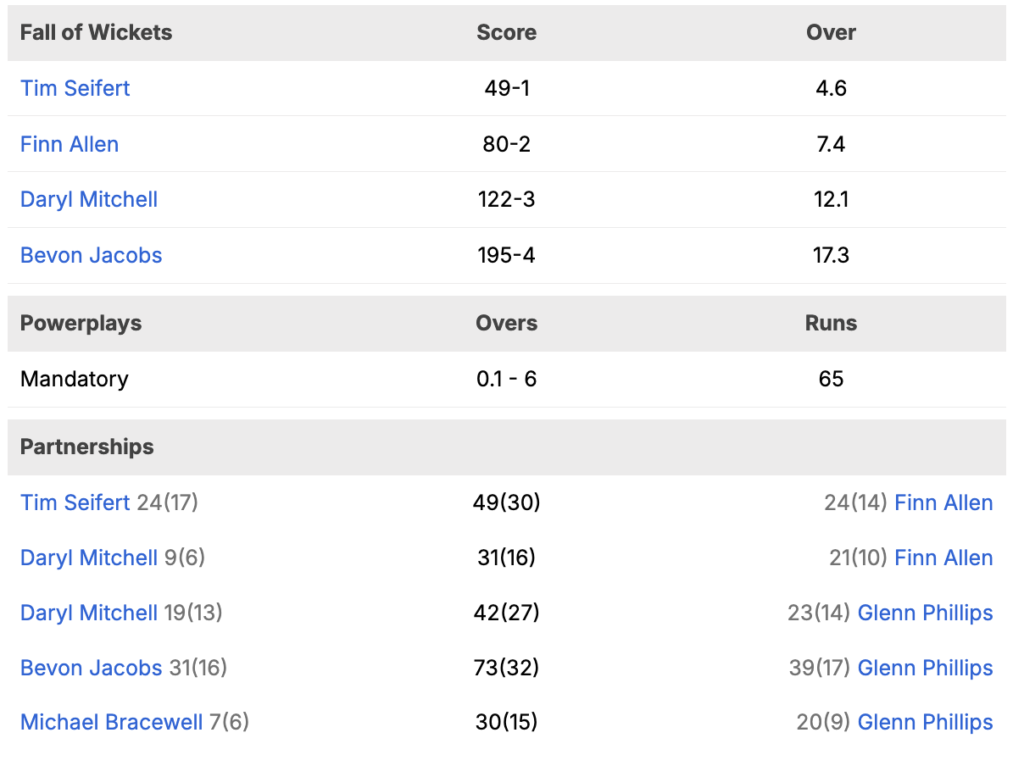
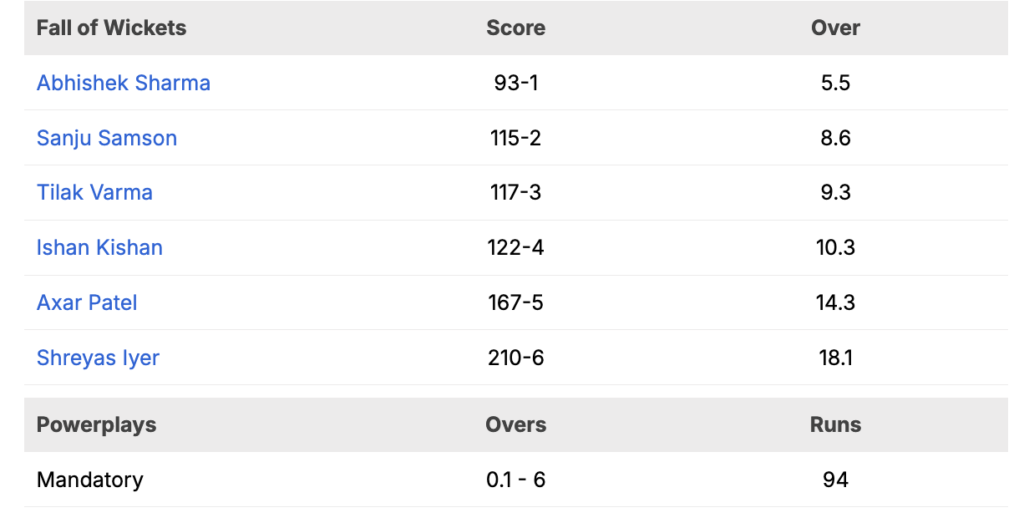
Fall of Wickets
The fall-of-wickets detail for both innings had not been published at the time of writing. Rather than infer the entries from the scores and dismissals available, the tables below are left for completion from the official scorecard.
Important Partnerships
One partnership figure is confirmed: Tim Seifert and Finn Allen put on 49 for New Zealand’s opening stand, reached inside the first five overs. The remaining partnership breakdowns for both innings are pending the official scorecard and should be added before publishing. Based on the batting order and the scores, India’s decisive stands involved Samson with Abhishek Sharma at the top and Naman Dhir with Nitish Kumar Reddy at the close — but the run figures for those stands are not yet available and have not been estimated here.
Player of the Match
The official Player of the Match award had not been published at the time of writing, and we are not going to guess it.
On the verified figures there are two obvious candidates and they sit on opposite sides of the result. Glenn Phillips made 82 not out from 40 balls in a losing cause and set up a record total. Sanju Samson made the highest score of the winning side’s innings with 67, while Naman Dhir’s unbeaten 42 was the innings that actually closed the chase out. Awards in high-scoring chases tend to go to the winning side, but that is a tendency, not a rule, and this section should be updated from the official record.
What the Result Means for the Series
India lead the five-match T20I series 1-0. The second T20I is at the same venue, Hagley Oval in Christchurch, on Saturday 24 October, with the series then moving to Wellington, Auckland and Hamilton before finishing on 1 November.
In the head-to-head record, India held a 19-11 advantage over New Zealand in T20Is before this match, from 31 completed meetings including one tie. This win takes that to 20-11.
Beyond the scoreline, the question the first match raises for India is about the bowling rather than the batting. Chasing 226 successfully is a statement; conceding 225 at a ground whose average first-innings score is 161 is a separate problem, and one the side has two days to think about before returning to the same pitch.
IND vs NZ 1st T20I 2026 – Match Statistics
| Metric | India | New Zealand |
|---|---|---|
| Total | 230/6 | 225/4 |
| Overs | 19.4 | 20 |
| Wickets lost | 6 | 4 |
| Highest individual score | Sanju Samson 67 | Glenn Phillips 82* |
| Extras | 17 | 8 |
| Leading wicket-taker | to be confirmed | to be confirmed |
| Best partnership | to be confirmed | 49 (Seifert & Allen, opening) |
| Result | India won by 4 wickets, with 2 balls remaining | |
| Player of the Match | to be confirmed | |
Highest individual score in the match: Glenn Phillips, 82 not out from 40 balls.
Frequently Asked Questions
Who won the IND vs NZ 1st T20I in 2026?
India won by four wickets at Hagley Oval, Christchurch, on 22 October 2026, chasing 226 and reaching 230 for 6 with two balls to spare. India lead the five-match series 1-0.
What was India’s score against New Zealand?
India made 230 for 6 in 19.4 overs. Sanju Samson top-scored with 67, Shreyas Iyer made 42 and Naman Dhir finished unbeaten on 42. Extras contributed 17.
What was New Zealand’s score against India?
New Zealand scored 225 for 4 in their 20 overs — their highest T20I total at home. Glenn Phillips made 82 not out, Finn Allen 45 and Bevon Jacobs 31.
Who scored the most runs in the match?
Glenn Phillips of New Zealand, with 82 not out from 40 balls. India’s highest scorer was Sanju Samson with 67.
Who was Player of the Match?
The official award had not been published at the time of writing. On the figures, Sanju Samson, Naman Dhir and Glenn Phillips are the leading candidates. This answer will be updated once the official record is available.
What was the highest individual score?
Glenn Phillips’ 82 not out from 40 balls, a strike rate just above 200. He batted through to the end of New Zealand’s innings.
Where was the first India vs New Zealand T20I played?
At Hagley Oval in Christchurch, New Zealand, as a day-night match on Thursday 22 October 2026. The second T20I is at the same ground on 24 October.
Where can readers find the full IND vs NZ scorecard?
The complete ball-by-ball scorecard, bowling analyses and fall of wickets are published on ESPNcricinfo and by New Zealand Cricket. Several figures in the tables above are marked pending and will be completed from that official record.
How many wickets did India lose during the chase?
Six. India lost Sanju Samson, Abhishek Sharma, Ishan Kishan, Shreyas Iyer, Tilak Varma and Axar Patel, finishing on 230 for 6 with Naman Dhir and Nitish Kumar Reddy not out.
Where can readers find the match highlights?
In India the series is broadcast on Sony Sports Network with streaming on SonyLIV, and official highlights are published through those platforms. Coverage is also carried on DD Sports.
Conclusion
This was a first T20I that told two stories. New Zealand produced the highest T20I total they have ever made at home, built on Finn Allen’s rapid start and Glenn Phillips’ unbeaten 82 from 40 balls, at a ground where 161 is par. And India chased it down anyway, losing two cheap middle-order wickets along the way, held together by Shreyas Iyer on his first outing as captain and finished by Naman Dhir.
India lead 1-0 with the second match at the same venue on Saturday. Follow our cricket section for the completed scorecard, the second T20I preview and full series coverage.