Pakistan vs England ODI Tri-Series Highlights: Pakistan Win by 87 Runs
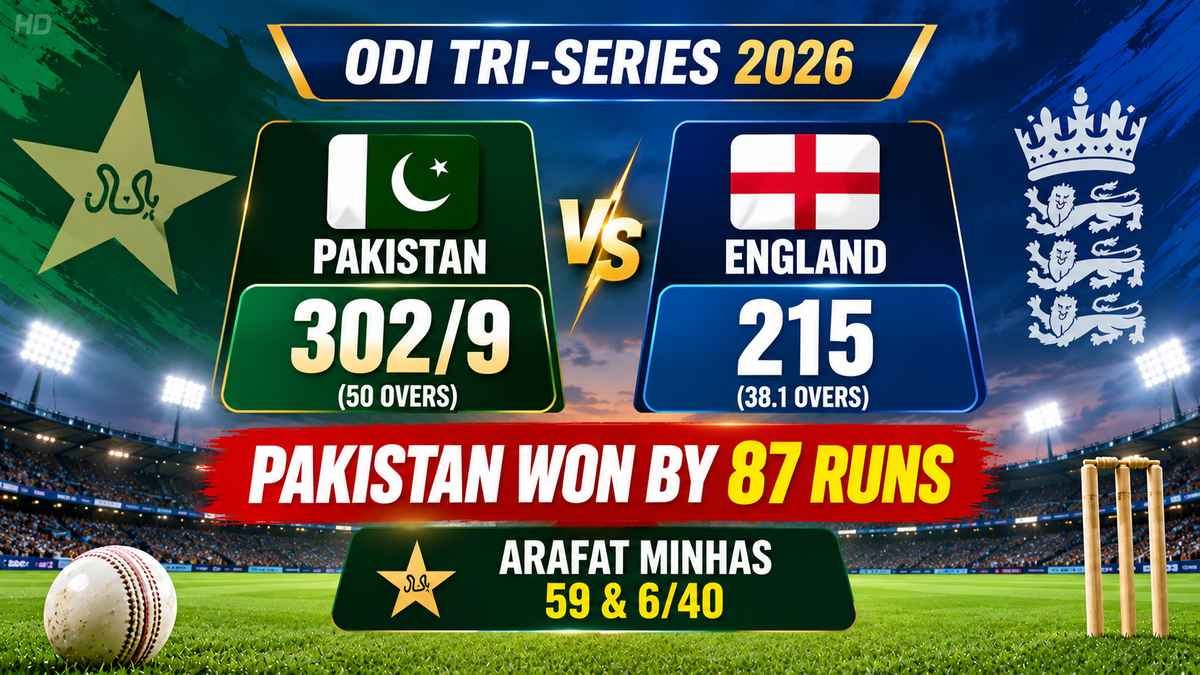
Pakistan beat England by 87 runs at the Rawalpindi Cricket Stadium on Tuesday, posting 302 for 9 before bowling England out for 215 in 38.4 overs. The match belonged almost entirely to one 21-year-old. Arafat Minhas made 59 off 58 balls to drag Pakistan out of a hole at 81 for 4, then returned with the ball and took 6 for 40 in 8.4 overs, turning an England chase that had reached 91 without loss into a collapse.
Pakistan’s innings and England’s were mirror images. One side recovered from early trouble to a total nobody would have predicted at the 15-over mark. The other squandered the best start of the match. In both cases the pivot was the same left-arm spinner.
Pakistan vs England Match Summary
| Team | Score | Overs |
|---|---|---|
| Pakistan | 302/9 | 50 |
| England | 215 all out | 38.4 |
| Match | Pakistan v England, 2nd match, ODI Tri-Series 2026-27 |
|---|---|
| Date | Tuesday, 20 October 2026 (day-night) |
| Venue | Rawalpindi Cricket Stadium, Rawalpindi |
| Result | Pakistan won by 87 runs |
| Player of the Match | Arafat Minhas — 59 off 58 balls and 6/40 |
| Series | Pakistan, England and Sri Lanka; the top two meet in the final |
Pakistan’s Batting Performance: Hasan Nawaz and Arafat Minhas Lead the Recovery
Asked to bat first, Pakistan lost Fakhar Zaman to the opening ball of the match, caught by Joe Root off Gus Atkinson. It set a tone that lasted most of an hour. Saim Ayub was bowled by Sonny Baker for 8, Pakistan were 31 for 2, and by the time the fourth wicket fell they had reached only 81 for 4. Babar Azam’s 34 had given the innings a brief spine before Will Jacks bowled him.
What followed was the innings. Hasan Nawaz made 79 off 74 balls, a controlled rather than spectacular effort, and he found a partner in Minhas who played with more freedom than a man in his fifth ODI might be expected to. Pakistan slipped again to 133 for 5 in the 27.3rd over, which is worth holding in mind: with 22 overs left they were barely past 130 and five down.
The stand between Nawaz and Minhas was worth 78 runs. When Jamie Overton bowled Nawaz, Minhas simply started again with Faheem Ashraf and added 72 more. Faheem’s contribution was the most violent of the innings — 39 off 26 balls — and Saad Baig’s 35, caught by Sam Curran off Atkinson, held the middle together.
Pakistan scored 91 runs in the last 10 overs. That is the number that decided the match. A side that was 133 for 5 finished on 302 for 9, and the difference between those two trajectories is almost exactly the eventual margin of victory.
England’s Bowling Performance
For 30 overs England’s attack did its job well. Sonny Baker finished with 3 for 65, the most wickets of any England bowler, and Gus Atkinson took 2 for 35, including the first ball of the match and the wicket of Saad Baig. Jacks, Overton and Adil Rashid each took one. Sam Curran’s 1 for 40 came from only five overs, which tells you something about how the back end of the innings went.
The problem was not the breakthroughs; England took wickets steadily throughout. It was that they could not finish the innings off. Having reduced Pakistan to 133 for 5 with more than 20 overs remaining, England needed one more clean strike and did not find it for 13 overs. Atkinson’s economy stayed respectable, but across the last ten overs Pakistan took 91, and a total that should have been in the 230s became one worth defending comfortably.
England’s Run Chase: A Strong Start Followed by a Collapse
Chasing 303, England began better than Pakistan had. Ben Duckett and Tom Banton put on 91 without loss inside 15 overs, scoring at a rate that made the target look ordinary. Banton made 57 off 53 balls and Duckett 45 off 46, and at that point England were ahead of the game by any measure.
Haris Rauf made the first incision, getting Duckett out with a short ball, and the opening stand was finally broken somewhere around the 117-120 mark. From there the innings came apart. Minhas had Banton caught at midwicket and bowled Harry Brook for 5. England were 128 for 3, still with batting to come and a manageable equation.
Joe Root’s 33 off 35 balls and Sam Curran’s 27 off 39 represented the last real resistance — a partnership of 31 from 57 balls, by which point the required rate had begun to climb. Naseem Shah removed Root. Rauf had Curran, finishing with 2 for 32. And then Minhas ran through the rest: Will Jacks made 19, Jordan Cox was lbw for 18, Adil Rashid and Overton managed one each, and Atkinson was run out by Minhas for 7 to finish the match.
England lost their last seven wickets for 50 runs, all out for 215 in 38.4 overs with Baker stranded on 1 not out. The collapse was not the product of a single unplayable spell so much as a batting order that kept losing wickets to the same bowler while the required rate did the rest. What it was not was a pitch problem — Pakistan had just made 302 on it.
Arafat Minhas Shines With Both Bat and Ball
It is worth stating plainly what Arafat Minhas did in a single day of international cricket, in only his fifth ODI, at the age of 21.
He came in with Pakistan 81 for 4 and made 59 off 58 balls with nine fours — his maiden ODI half-century, his previous best being 33. He was at the crease for both of the innings’ major stands, 78 with Nawaz and 72 with Faheem Ashraf, and he was still there for the surge that produced 91 runs from the final ten overs.
Then he took 6 for 40 from 8.4 overs, career-best figures, dismissing Banton and Brook to start the collapse and returning to clean up the tail. He bowled a hat-trick ball. He ran out Atkinson for the final wicket. His analysis of 8.4 overs is itself a detail worth noticing: England were bowled out in 38.4, meaning Minhas was the bowler at the moment the match ended.
The context makes it more striking rather than less. On his ODI debut against Australia on 30 May 2026 he took 5 for 32 in ten overs, becoming the first spinner and the first Pakistan bowler to take five wickets on ODI debut. A slow left-arm orthodox bowler who bats left-handed, he had taken seven ODI wickets in total before this match. He has now taken thirteen.
A fifty and a six-wicket haul in the same one-day international is a rare combination at any stage of a career. In a fifth appearance, it is the sort of performance that reframes how a selection panel thinks about a player — from a prospect worth developing to a cricketer who wins matches on his own.
Key Turning Points in Pakistan vs England
- Pakistan rebuilding from 81 for 4. A total under 200 looked likely. Every subsequent event in the match depended on this not happening.
- The 78-run stand between Hasan Nawaz and Arafat Minhas. Begun at 133 for 5, it moved Pakistan from a position where England were winning to one where a par score was in reach.
- The last ten overs of Pakistan’s innings. Ninety-one runs, driven by Minhas and Faheem Ashraf’s 39 off 26. This is where the 87-run margin was built.
- Haris Rauf breaking the opening stand. England were 91 without loss and in control. Duckett’s dismissal ended the only phase of the chase they dominated.
- Minhas removing Banton and Brook. From 128 for 3 with a set batter gone and the captain back for 5, England’s chase stopped being an equation and became a rescue mission.
Pakistan vs England Full Scorecard
Pakistan — leading run-scorers
| Batter | Runs | Balls | Notes |
|---|---|---|---|
| Hasan Nawaz | 79 | 74 | b Overton |
| Arafat Minhas | 59 | 58 | 9 fours; maiden ODI fifty |
| Faheem Ashraf | 39 | 26 | — |
| Saad Baig | 35 | — | c Curran b Atkinson |
| Babar Azam | 34 | — | b Jacks |
| Saim Ayub | 8 | — | b Baker |
| Fakhar Zaman | 0 | 1 | c Root b Atkinson, first ball of the match |
Total: 302 for 9 in 50 overs. Key phases: 31/2, 81/4, 133/5 (27.3 overs), 91 runs scored in the last 10 overs.
England — leading run-scorers
| Batter | Runs | Balls | Notes |
|---|---|---|---|
| Tom Banton | 57 | 53 | c midwicket b Arafat Minhas |
| Ben Duckett | 45 | 46 | b Haris Rauf |
| Joe Root | 33 | 35 | b Naseem Shah |
| Sam Curran | 27 | 39 | b Haris Rauf |
| Will Jacks | 19 | — | — |
| Jordan Cox | 18 | — | lbw |
| Gus Atkinson | 7 | — | run out (Arafat Minhas) |
| Harry Brook | 5 | — | b Arafat Minhas |
| Adil Rashid | 1 | — | — |
| Jamie Overton | 1 | — | c long-on |
| Sonny Baker | 1* | — | not out |
Total: 215 all out in 38.4 overs. Key phases: 91/0 (15 overs), 128/3, last seven wickets fell for 50 runs.
Pakistan bowling
| Bowler | Overs | Runs | Wickets |
|---|---|---|---|
| Arafat Minhas | 8.4 | 40 | 6 |
| Haris Rauf | — | 32 | 2 |
| Naseem Shah | — | — | 1 |
England bowling
| Bowler | Overs | Runs | Wickets |
|---|---|---|---|
| Sonny Baker | — | 65 | 3 |
| Gus Atkinson | — | 35 | 2 |
| Sam Curran | 5 | 40 | 1 |
| Jamie Overton | — | — | 1 |
| Will Jacks | — | — | 1 |
| Adil Rashid | — | — | 1 |
Dashes indicate figures not published in the sources used for this report. For the complete over-by-over analysis and the full fall of wickets, see the official scorecard on the Pakistan Cricket Board site or ESPNcricinfo.
What This Victory Means for Pakistan in the ODI Tri-Series
This was Pakistan’s second consecutive win in the tournament. They opened by beating Sri Lanka by 37 runs on 18 October, and they now have two results from two matches, both achieved by defending a total rather than chasing one.
The format is straightforward: Pakistan, England and Sri Lanka, with the top two progressing to the final. Pakistan are in a strong position, though with matches still to play the arithmetic is not settled, and nothing here guarantees anything.
| Date | Match | Venue |
|---|---|---|
| Thu, 22 Oct | Sri Lanka v England | Rawalpindi |
| Sun, 25 Oct | Pakistan v England | Lahore |
| Tue, 27 Oct | Pakistan v Sri Lanka | Lahore |
| Thu, 29 Oct | Sri Lanka v England | Lahore |
| Sat, 31 Oct | Final | Lahore |
England’s position is more awkward. They have a defeat on the board and face Sri Lanka on Thursday before a return meeting with Pakistan in Lahore on 25 October. The batting problem they will want to address is specific rather than general: 91 for 0 is not a failure of a top order, and 215 all out is not the fault of one. Losing seven wickets for 50 to a 21-year-old spinner is the thing to fix.
Frequently Asked Questions
Who won the Pakistan vs England ODI Tri-Series match on 20 October 2026?
Pakistan won by 87 runs at the Rawalpindi Cricket Stadium, making 302 for 9 before bowling England out for 215.
What was Pakistan’s score against England?
Pakistan scored 302 for 9 in their 50 overs, recovering from 81 for 4 and 133 for 5.
How many runs did England score?
England were bowled out for 215 in 38.4 overs, chasing a target of 303.
Who was the Player of the Match in Pakistan vs England?
Arafat Minhas, for scoring 59 off 58 balls and then taking 6 for 40.
How many wickets did Arafat Minhas take against England?
Six. His figures were 6 for 40 from 8.4 overs, a career best, and he also ran out Gus Atkinson for the final wicket.
How many runs did Arafat Minhas score?
59 off 58 balls, with nine fours. It was his maiden ODI half-century, in only his fifth ODI.
Who was England’s highest run-scorer?
Tom Banton, with 57 off 53 balls. Ben Duckett made 45 off 46 in an opening stand of 91.
Where was the Pakistan vs England ODI match played?
At the Rawalpindi Cricket Stadium in Rawalpindi, Pakistan, as a day-night match on 20 October 2026.
Conclusion
Pakistan won this match twice over. First by refusing to fold at 81 for 4 and then at 133 for 5, and second by taking 91 runs from the final ten overs to turn a modest position into 302 for 9. England’s reply had everything it needed for 15 overs and almost nothing after that, falling from 91 without loss to 215 all out as their last seven wickets went down for 50 runs.
The common thread was Arafat Minhas. A maiden ODI fifty that rescued one innings, and 6 for 40 that dismantled the other, in his fifth international appearance at 21. Pakistan move to two wins from two and face England again in Lahore on 25 October.
Follow our cricket section for full scorecards, match reports and tri-series standings as the tournament continues.
Published: 21 October 2026. Last updated: 21 October 2026. Statistics verified against match reporting and official scorecards. Where a figure was not published in the sources available, it has been left blank rather than estimated.